Kotlin

kotlin collections

Mastering Kotlin Collections: A Comprehensive Guide to Boosting Your Code Efficiency and Productivity

Kotlin, a modern programming language for the JVM, comes with a robust and expressive set of collection classes and functions. Kotlin collections provide a seamless way to work with data, enabling efficient data manipulation, transformation, and filtering. Whether you’re a beginner or an experienced Kotlin developer, understanding the various collection types, operations, and best practices is essential. In this article, we will explore Kotlin collections in depth, covering all aspects and providing practical examples to solidify your understanding.

What are Kotlin Collections?

In Kotlin, collections refer to data structures that can hold multiple elements. They provide a way to store, retrieve, and manipulate groups of related objects. Kotlin provides a rich set of collection classes and interfaces in its standard library, making it convenient to work with collections in various scenarios.

Here are some commonly used collection interfaces in Kotlin:

  1. Collection: The root interface for read-only collections. It provides methods for accessing elements, such as iteration, size checking, and element presence checks.
  2. MutableCollection: Extends the Collection interface and adds methods for modifying the collection, such as adding and removing elements.
  3. List: Represents an ordered collection of elements. Elements can be accessed by their indices. Kotlin provides ArrayList and LinkedList as implementations of the List interface.
  4. MutableList: Extends the List interface and adds methods for modifying the list, such as adding, removing, and modifying elements.
  5. Set: Represents a collection of unique elements, with no defined order. Kotlin provides HashSet and LinkedHashSet as implementations of the Set interface.
  6. MutableSet: Extends the Set interface and adds methods for modifying the set.
  7. Map: Represents a collection of key-value pairs. Each key in the map is unique, and you can retrieve the corresponding value using the key. Kotlin provides HashMap and LinkedHashMap as implementations of the Map interface.
  8. MutableMap: Extends the Map interface and adds methods for modifying the map.

These are just a few examples of collection interfaces in Kotlin. The standard library also includes other collection interfaces and their corresponding implementations, such as SortedSet, SortedMap, and Queue, along with various utility functions and extension functions to work with collections more efficiently.

Collections in Kotlin provide a convenient way to handle groups of data and perform common operations like filtering, mapping, sorting, and more. They play a vital role in many Kotlin applications and can greatly simplify data manipulation tasks.

Read-Only and Mutable Collections

Kotlin collection design separates interfaces for accessing and modifying data in collections. This design distinguishes between read-only and mutable interfaces, providing clarity and control over how collections are used and modified.
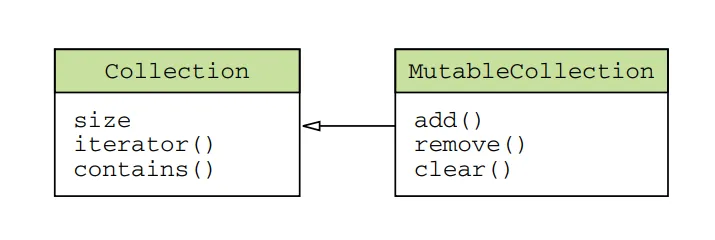
The kotlin.collections.Collection interface is used for accessing data in a collection. It allows you to iterate over the elements, obtain the size, check for the presence of specific elements, and perform other read operations. However, it does not provide methods for adding or removing elements.

Kotlin
fun printCollection(collection: Collection<Int>) {
    for (element in collection) {
        println(element)
    }
}

val myList = listOf(1, 2, 3)
printCollection(myList) // This works fine

To modify the data in a collection, you should use the kotlin.collections.MutableCollection interface. It extends the Collection interface and adds methods for adding and removing elements, clearing the collection, and other modification operations.

Kotlin
fun addToCollection(collection: MutableCollection<Int>, element: Int) {
    collection.add(element)
}

val myMutableList = mutableListOf(1, 2, 3)
addToCollection(myMutableList, 4) // This modifies the collection

Creating a defensive copy

By using read-only interfaces (Collection) throughout your code, you convey that the collection won’t be modified. If a function accepts a Collection parameter, you can be confident that it only reads data from the collection. On the other hand, when a function expects a MutableCollection, it indicates that the collection will be modified. If you have a collection that is part of your component’s internal state and needs to be passed to a function requiring a MutableCollection, you may need to create a defensive copy of that collection to ensure its integrity.

Kotlin
fun modifyCollection(collection: MutableCollection<Int>) {
    val defensiveCopy = collection.toList()
    // Perform modifications on the defensiveCopy
    // ...
}

val originalList = mutableListOf(1, 2, 3)
modifyCollection(originalList) // The original list remains unchanged

In this example, we have a function modifyCollection that takes a mutable collection as a parameter. However, if the collection is part of your component’s internal state and you want to ensure its integrity, you can create a defensive copy of the collection before passing it to the function.

By calling toList() on the original collection, we create a new read-only list defensiveCopy that contains the same elements. The modifyCollection function can then perform any modifications on the defensive copy without affecting the original collection.

This approach allows you to protect the original collection from unintended modifications, especially when it is part of the component’s internal state or when you want to ensure its immutability in certain scenarios.

Immutable Collections

Kotlin offers a variety of immutable collection types, such as lists, sets, and maps, that cannot be modified once created. These collections guarantee thread safety and immutability, ensuring data integrity in multi-threaded scenarios. Let’s see some examples:

Kotlin
val numbers = listOf(1, 2, 3, 4, 5)  // Immutable list
val setOfColors = setOf("red", "green", "blue")  // Immutable set
val mapOfUsers = mapOf(1 to "Alice", 2 to "Bob", 3 to "Charlie")  // Immutable map

However, it’s important to note that read-only collections are not necessarily immutable. A read-only collection interface can be one of many references to the same collection. Other references to the collection may have mutable interfaces, allowing modifications.

This means that if you have concurrent code or multiple references to the same collection, modifications from other codes can occur while you’re working with it. This can lead to issues such as ConcurrentModificationException errors. To handle such situations, you need to ensure proper synchronization of access to the data or use data structures that support concurrent access when working in a multi-threaded environment.

Consider the following code snippet:

Kotlin
val mutableList = mutableListOf(1, 2, 3)
val readOnlyList: List<Int> = mutableList

// Concurrent modification by another reference
mutableList.add(4)

// Accessing the read-only list
readOnlyList.forEach { println(it) }

In this example, we have a mutable list called mutableList and a read-only list called readOnlyList, which is a reference to the same underlying list. Initially, both lists contain elements [1, 2, 3].

However, the mutableList is mutable, so we can add an element (4) to it. After adding the element, the mutableList becomes [1, 2, 3, 4].

Now, let’s try to iterate over the elements in the readOnlyList using the forEach function. We might expect it to print [1, 2, 3], but what actually happens?

Since the readOnlyList is just a read-only view of the same underlying list, any modifications made to the mutableList will affect the readOnlyList as well. In this case, we added an element to the mutableList, causing the readOnlyList to contain [1, 2, 3, 4]. As a result, when we iterate over the elements in readOnlyList, it will print [1, 2, 3, 4] instead of [1, 2, 3].

This behavior can lead to unexpected results and even errors like ConcurrentModificationException. If you have concurrent code or multiple references to the same collection, modifications made by one reference can affect the others, potentially causing data inconsistencies or errors.

To handle such situations, you need to ensure proper synchronization of access to the data or use data structures that support concurrent access. For example, you can use synchronized blocks or locks to control access to the collection in a multi-threaded environment. Alternatively, you can use concurrent data structures provided by the Kotlin standard library, such as ConcurrentHashMap, which are designed to handle concurrent modifications safely.

It’s crucial to be aware of these considerations when working with read-only collections that are shared among multiple references or used in concurrent scenarios.

Kotlin collections and Java

In Kotlin, every collection type is an instance of the corresponding Java collection interface. This means that Kotlin collections seamlessly integrate with Java collections without requiring any conversion, wrappers, or data copying.
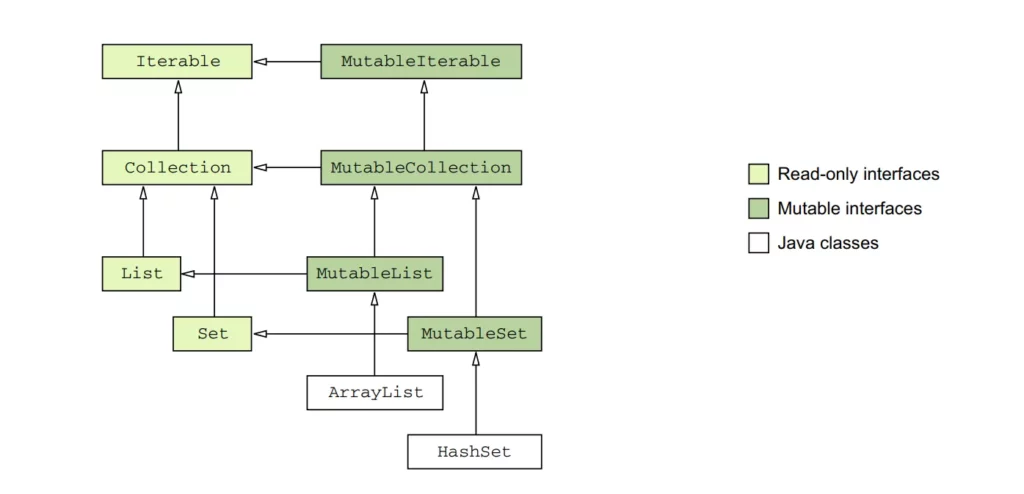
However, in Kotlin, each Java collection interface has two representations: a read-only version and a mutable version. The read-only interfaces mirror the structure of the Java collection interfaces but lack mutating methods, while the mutable interfaces extend their corresponding read-only interfaces and provide mutating methods.

For example, the Java class java.util.ArrayList is treated as if it inherited from the MutableList interface. This means that you can use an ArrayList instance in Kotlin as if it were a MutableList, and you can call the methods defined in the MutableList interface on an ArrayList object. Similarly, the Java class java.util.HashSet is treated as if it inherited from the MutableSet interface, allowing you to use a HashSet instance as a MutableSet.

Other Java collection implementations, such as LinkedList and SortedSet, have similar supertypes in Kotlin. This means that LinkedList is treated as if it inherited from a related interface, and SortedSet is also treated as if it inherited from a corresponding Kotlin interface. These interfaces provide a common set of methods that can be used across different implementations.

The purpose of treating Java classes as if they inherited from their corresponding Kotlin interfaces is to provide compatibility and allow seamless interoperability between Kotlin and Java collections. Kotlin provides both mutable and read-only interfaces, allowing for clear separation and appropriate usage of collections depending on whether you need to mutate them or not.

What about Map?

Similarly, the Map class (which doesn’t extend Collection or Iterable) in Java has two versions in Kotlin: Map (read-only) and MutableMap (mutable). These versions provide different sets of functions for working with maps.

When calling a Java method that expects a collection as a parameter, you can pass a Kotlin collection directly without any extra steps. Kotlin handles the interoperability between Kotlin collections and Java collections seamlessly.

However, there is an important caveat to consider. Since Java does not distinguish between read-only and mutable collections, Java code can modify a collection even if it’s declared as read-only on the Kotlin side. The Kotlin compiler cannot fully analyze the modifications made by Java code, so Kotlin cannot reject a call passing a read-only collection to Java code that modifies it.

As a result, when writing a Kotlin function that passes a collection to Java code, it’s your responsibility to use the correct type for the parameter based on whether the Java code will modify the collection or not.

Kotlin collection interfaces

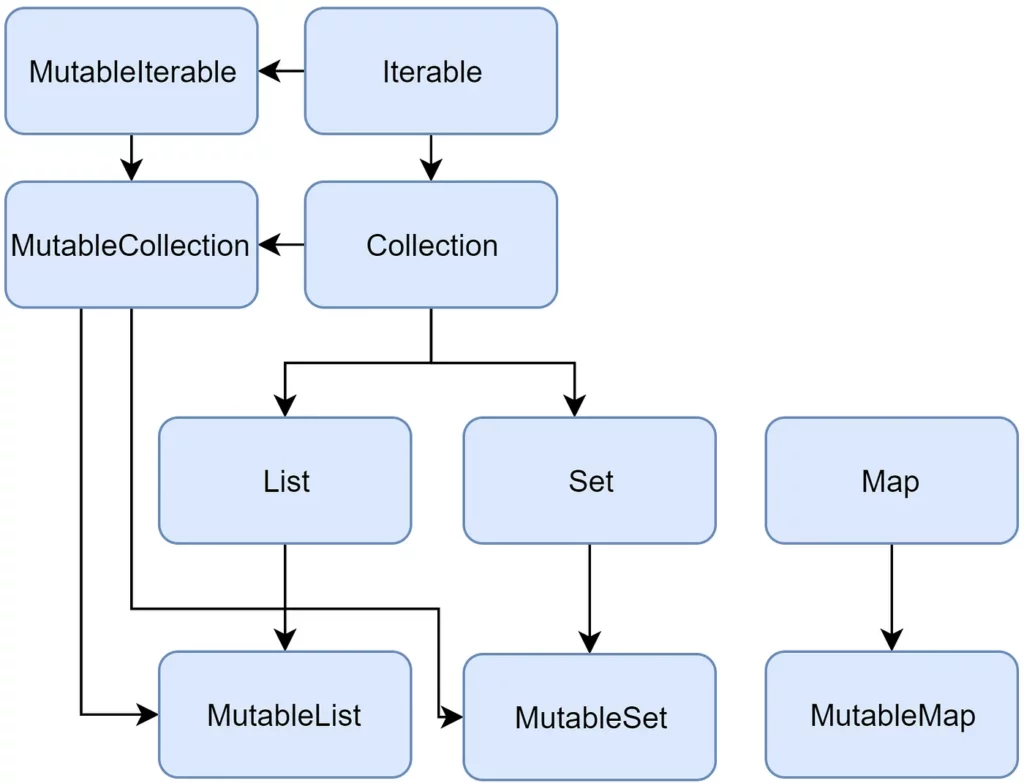
Now we will delve deep into the collection interfaces and explore their implementations, enabling you to leverage the full power of Kotlin collections in your projects.

Below is a diagram of the Kotlin collection interfaces:
Collection

The Collection<T> interface serves as the foundation of the collection hierarchy in Kotlin. It represents the common behavior of read-only collections and provides essential operations such as retrieving the size of the collection and checking if an item is present.

In addition, the Collection inherits from the Iterable<T> interface, which defines operations for iterating over elements in a collection. This allows you to use Collection as a parameter in functions that work with different collection types, providing a versatile way to handle collections in your code.

However, for more specific scenarios, it’s recommended to use the inheritors of Collection: List and Set. These inheritors offer additional functionality tailored to their respective purposes. Let’s see some examples:

Kotlin
// Using Collection as a parameter
fun printCollectionSize(collection: Collection<Int>) {
    println("Collection size: ${collection.size}")
}

val list: List<Int> = listOf(1, 2, 3, 4, 5)
val set: Set<Int> = setOf(1, 2, 3, 4, 5)

printCollectionSize(list)  // Output: Collection size: 5
printCollectionSize(set)  // Output: Collection size: 5

// Using List and Set directly
val listItems: List<String> = listOf("apple", "banana", "orange")
val setItems: Set<String> = setOf("apple", "banana", "orange")

println(listItems.size)  // Output: 3
println(setItems.contains("banana"))  // Output: true

In the example above, we demonstrate the usage of Collection as a parameter in the printCollectionSize function, which can accept both List and Set. Additionally, we directly use the List and Set interfaces to access their specific methods, such as retrieving the size or checking for item membership.

List

The List<T> interface in Kotlin stores elements in a specific order and provides indexed access to them. The indices start from zero, representing the first element, and go up to lastIndex, which is equal to (list.size — 1).

A List allows duplicate elements (including nulls), meaning it can contain any number of equal objects or occurrences of a single object. When comparing lists for equality, they are considered equal if they have the same sizes and structurally equal elements at the same positions.

The MutableList<T> interface extends List and provides additional write operations specifically designed for lists. These operations allow you to add or remove an element at a specific position within the list.

While lists share similarities with arrays, there is one crucial difference: an array’s size is fixed upon initialization and cannot be changed, whereas a list does not have a predefined size. Instead, a list’s size can be modified through write operations like adding, updating, or removing elements.

In Kotlin, the default implementation of MutableList is ArrayList, which can be visualized as a resizable array that dynamically adjusts its size based on the number of elements it contains. This provides flexibility and allows you to manipulate the list as needed.

Let’s illustrate the concepts with a simple example:

Kotlin
// Creating a list and accessing elements
val fruits: List<String> = listOf("apple", "banana", "orange")
println(fruits[1])  // Output: banana

// Creating a mutable list and modifying elements
val mutableFruits: MutableList<String> = mutableListOf("apple", "banana", "orange")
mutableFruits.add("grape")
mutableFruits[1] = "kiwi"
mutableFruits.removeAt(0)
println(mutableFruits)  // Output: [kiwi, orange, grape]

In the example above, we first create an immutable list of fruits. We can access individual elements using the indexing syntax (fruits[1]) and retrieve the element at the specified position.

Next, we create a mutable list of fruits using MutableList. This allows us to perform write operations on the list. We add a new element with add, update an element at index 1 using indexing assignment (mutableFruits[1] = "kiwi"), and remove an element at a specific position using removeAt. Finally, we print the modified list.

Set

The Set<T> interface in Kotlin stores unique elements, and their order is generally undefined. In a Set, duplicate elements are not allowed, except for a single occurrence of null. Comparing two sets for equality depends on their sizes and whether each element in one set has an equal element in the other set.

The MutableSet interface extends MutableCollection and provides write operations specific to sets. This allows you to add or remove elements from the set.

Let’s illustrate the concepts with an example:

Kotlin
// Creating a set and adding elements
val numbers: Set<Int> = setOf(1, 2, 3, 4, 5)
println(numbers)  // Output: [1, 2, 3, 4, 5]

// Creating a mutable set and modifying elements
val mutableNumbers: MutableSet<Int> = mutableSetOf(1, 2, 3, 4, 5)
mutableNumbers.add(6)
mutableNumbers.remove(3)
println(mutableNumbers)  // Output: [1, 2, 4, 5, 6]

In the example above, we first create an immutable set of numbers. Since sets store unique elements, any duplicate values are automatically eliminated.

Next, we create a mutable set of numbers using MutableSet. This allows us to perform write operations on the set. We add a new element with add and remove an element with remove. Finally, we print the modified set.

Set<T> interface provides a way to store unique elements without a specific order. The default implementation for MutableSet<T> is LinkedHashSet, which preserves the order of element insertion. This means that the elements in a LinkedHashSet are ordered based on the order in which they were added, ensuring predictable results when using functions like first() or last().

Let’s see an example to understand this behavior:

Kotlin
// Creating a LinkedHashSet
val linkedSet: MutableSet<String> = linkedSetOf("apple", "banana", "orange", "kiwi")
println(linkedSet.first())  // Output: apple
println(linkedSet.last())  // Output: kiwi

In the above example, we create a MutableSet using linkedSetOf, which creates a LinkedHashSet. The order of the elements in the set is preserved based on their insertion order. When we call first(), it returns the first element, which is “apple”. Similarly, last() returns the last element, which is “kiwi”. Since LinkedHashSet maintains the insertion order, these functions give predictable results.

On the other hand, the HashSet implementation does not guarantee any specific order of elements. Therefore, calling functions like first() or last() on a HashSet can yield unpredictable results. However, HashSet requires less memory compared to LinkedHashSet, making it more memory-efficient for storing the same number of elements.

Let’s see an example using HashSet:

Kotlin
// Creating a HashSet
val hashSet: MutableSet<String> = hashSetOf("apple", "banana", "orange", "kiwi")
println(hashSet.first())  // Output: unpredictable
println(hashSet.last())  // Output: unpredictable

In the above example, we create a MutableSet using hashSetOf, which creates a HashSet. The order of the elements in the set is not guaranteed. Therefore, calling first() or last() on a HashSet can give unpredictable results. The output can vary each time you run the code.

Map

The Map<K, V> interface in Kotlin is a collection type that stores key-value pairs, also known as entries. Unlike other collection interfaces, Map does not inherit from the Collection interface. However, it provides specific functions for accessing values by their corresponding keys, searching for keys and values, and more.

In a Map, keys are unique, meaning that each key can be associated with only one value. However, different keys can be paired with equal values. Comparing two maps for equality depends on the key-value pairs they contain, regardless of the order in which the pairs are stored.

Kotlin
fun main() {
    val numbersMap = mapOf("key1" to 1, "key2" to 2, "key3" to 3, "key4" to 1)    
    val anotherMap = mapOf("key2" to 2, "key1" to 1, "key4" to 1, "key3" to 3)

    println("The maps are equal: ${numbersMap == anotherMap}")
}

The MutableMap interface extends Map and provides additional write operations specific to maps. These operations allow you to add new key-value pairs or update the value associated with a given key.

The default implementation of MutableMap is LinkedHashMap, which preserves the order of element insertion when iterating over the map. This means that when you iterate over a LinkedHashMap, the elements will be returned in the same order in which they were added. On the other hand, HashMap does not guarantee any specific order of elements and is more focused on performance and memory efficiency.

Let’s see an example to understand the concepts:

Kotlin
// Creating a map and accessing values by key
val ages: Map<String, Int> = mapOf("John" to 25, "Jane" to 30, "Alice" to 35)
println(ages["John"])  // Output: 25

// Creating a mutable map and modifying values
val mutableAges: MutableMap<String, Int> = mutableMapOf("John" to 25, "Jane" to 30, "Alice" to 35)
mutableAges["John"] = 26
mutableAges["Bob"] = 40
mutableAges.remove("Jane")
println(mutableAges)  // Output: {John=26, Alice=35, Bob=40}

In the above example, we first create an immutable map of ages, where each person’s name is paired with their age. We can access the values by providing the corresponding key (ages["John"]).

Next, we create a mutable map of ages using MutableMap. This allows us to perform write operations on the map. We update the value associated with the key “John” using indexing assignment (mutableAges["John"] = 26), add a new key-value pair with mutableAges["Bob"] = 40, and remove a key-value pair using remove. Finally, we print the modified map.

Commonly Used Collection Implementations

Kotlin provides several commonly used collection implementations that offer different characteristics and performance trade-offs. Let’s explore some of these implementations:

ArrayList

ArrayList is an implementation of the MutableList interface and provides dynamic arrays that can grow or shrink in size. It offers fast element retrieval by index and efficient random access operations.

Kotlin
val arrayList: ArrayList<String> = ArrayList()
arrayList.add("Apple")
arrayList.add("Banana")
arrayList.add("Orange")

println(arrayList)  // Output: [Apple, Banana, Orange]

LinkedList

LinkedList is an implementation of the MutableList interface that represents a doubly-linked list. It allows efficient element insertion and removal at both ends of the list but has slower random access compared to ArrayList.

Kotlin
val linkedList: LinkedList<String> = LinkedList()
linkedList.add("Apple")
linkedList.add("Banana")
linkedList.add("Orange")

println(linkedList)  // Output: [Apple, Banana, Orange]

HashSet

HashSet is an implementation of the MutableSet interface that stores elements in an unordered manner. It ensures the uniqueness of elements by using hash codes and provides fast membership checking.

Kotlin
val hashSet: HashSet<String> = HashSet()
hashSet.add("Apple")
hashSet.add("Banana")
hashSet.add("Orange")

println(hashSet)  // Output: [Apple, Banana, Orange]

TreeSet

TreeSet is an implementation of the MutableSet interface that stores elements in sorted order based on their natural order or a custom comparator. It provides efficient operations for retrieving elements in a sorted manner.

Kotlin
val treeSet: TreeSet<String> = TreeSet()
treeSet.add("Apple")
treeSet.add("Banana")
treeSet.add("Orange")

println(treeSet)  // Output: [Apple, Banana, Orange]

HashMap

HashMap is an implementation of the MutableMap interface that stores key-value pairs. It provides fast lookup and insertion operations based on the hash codes of keys.

Kotlin
val hashMap: HashMap<String, Int> = HashMap()
hashMap["Apple"] = 1
hashMap["Banana"] = 2
hashMap["Orange"] = 3

println(hashMap)  // Output: {Apple=1, Banana=2, Orange=3}

TreeMap

TreeMap is an implementation of the MutableMap interface that stores key-value pairs in a sorted order based on the natural order of keys or a custom comparator. It provides efficient operations for retrieving entries in a sorted manner.

Kotlin
val treeMap: TreeMap<String, Int> = TreeMap()
treeMap["Apple"] = 1
treeMap["Banana"] = 2
treeMap["Orange"] = 3

println(treeMap)  // Output: {Apple=1, Banana=2, Orange=3}

These are some of the commonly used collection implementations in Kotlin. Each implementation has its own characteristics and usage scenarios, so choose the one that best fits your requirements in terms of performance, order, uniqueness, or sorting.

Iterable

When working with collections in Kotlin, traversing through the elements is a common requirement. The Kotlin standard library provides mechanisms such as iterators and for loops to facilitate this traversal.

Iterators

Iterators are objects that allow sequential access to the elements of a collection without exposing the underlying structure of the collection. You can obtain an iterator for inheritors of the Iterable<T> interface, including Set and List, by calling the iterator() function on the collection.

Here’s an example of using an iterator to traverse a collection:

Kotlin
val numbers = listOf(1, 2, 3, 4, 5)
val iterator = numbers.iterator()

while (iterator.hasNext()) {
    val element = iterator.next()
    println(element)
}

In the above example, we create a List of numbers and obtain an iterator by calling iterator() on the list. We then use a while loop to iterate through the elements. The hasNext() function checks if there is another element, and next() retrieves the current element and moves the iterator to the next position. We can perform operations on each element, such as printing its value.

Alternatively, Kotlin provides a more concise way to iterate through a collection using the for loop:

Kotlin
val numbers = listOf(1, 2, 3, 4, 5)

for (element in numbers) {
    println(element)
}

In this case, the for loop implicitly obtains the iterator and iterates over the elements of the collection.

Additionally, the standard library provides the forEach() function, which simplifies iterating over a collection and executing code for each element:

Kotlin
val numbers = listOf(1, 2, 3, 4, 5)

numbers.forEach { element ->
    println(element)
}

The forEach() function takes a lambda expression as an argument, and the code within the lambda is executed for each element in the collection.

ListIterator

For lists, there is a special iterator implementation called ListIterator. It supports iterating through lists in both forward and backward directions. The ListIterator provides functions such as hasPrevious(), previous(), nextIndex(), and previousIndex() to facilitate backward iteration and retrieve information about element indices.

Kotlin
val colors = listOf("red", "green", "blue")
val listIterator = colors.listIterator()

while (listIterator.hasNext()) {
    val element = listIterator.next()
    println(element)
}

while (listIterator.hasPrevious()) {
    val element = listIterator.previous()
    println(element)
}

In the above code, we create a list of colors and obtain a ListIterator by calling listIterator() on the list. We then use a while loop to iterate through the list in the forward direction using next().

After reaching the end of the list, we use another while loop to iterate in the backward direction using previous(). This allows us to traverse the list from the last element back to the first element.

MutableIterator

For mutable collections, there is MutableIterator, which extends Iterator and provides the remove() function. This allows you to remove elements from a collection while iterating over it. In addition, MutableListIterator allows the insertion and replacement of elements while iterating through a list.

Kotlin
val numbers = mutableListOf(1, 2, 3, 4, 5)
val iterator = numbers.iterator()

while (iterator.hasNext()) {
    val element = iterator.next()
    if (element % 2 == 0) {
        iterator.remove()
    }
}

println(numbers)  // Output: [1, 3, 5]

In the above code, we create a mutable list of numbers and obtain a MutableIterator by calling iterator() on the list. We iterate through the list using a while loop and remove the even numbers using remove() when encountered.

After iterating, we print the modified list, which now contains only the odd numbers.

By using ListIterator, you can traverse lists in both forward and backward directions, while MutableIterator allows you to remove elements from mutable collections during iteration. These iterators provide flexibility and control when working with lists and mutable collections in Kotlin.

Collection Creation Function In Kotlin

To create a collection in Kotlin, you can use the various collection classes provided by the Kotlin standard library, such as List, MutableList, Set, MutableSet, Map, and MutableMap. These classes have constructors and factory functions to create collections with initial elements.
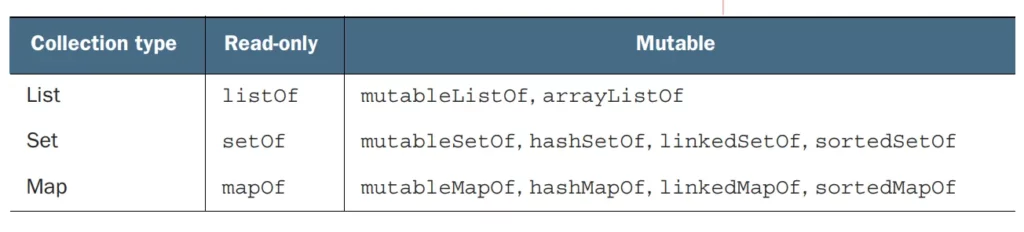
Here’s an example of how we can create different types of collections in Kotlin:

Kotlin
val list = listOf("apple", "banana", "orange")   // Creating a List

val mutableList = mutableListOf("apple", "banana", "orange")   // Creating a MutableList

val set = setOf("apple", "banana", "orange")   // Creating a Set

val mutableSet = mutableSetOf("apple", "banana", "orange")   // Creating a MutableSet

val map = mapOf(1 to "apple", 2 to "banana", 3 to "orange")   // Creating a Map

val mutableMap = mutableMapOf(1 to "apple", 2 to "banana", 3 to "orange")   // Creating a MutableMap

You can replace the initial elements with your own data or leave the collections empty if you want to populate them later.

Note: The examples above use immutable (val) collections, which means you cannot modify their contents once created. If you need to modify the collection, you can use their mutable counterparts (MutableList, MutableSet, MutableMap) and add or remove elements as needed.

Empty collections

In Kotlin, there are convenient functions for creating empty collections: emptyList(), emptySet(), and emptyMap(). These functions allow you to create collections without any elements.

When using these functions, it’s important to specify the type of elements that the collection will hold. This helps the compiler infer the appropriate type for the collection and enables type safety during compile-time checks.

Here’s an example of using the emptyList() function:

Kotlin
val emptyStringList: List<String> = emptyList()

In the above example, we create an empty List of Strings using emptyList(). By specifying the type parameter <String>, we ensure that the list can only hold String elements. This helps avoid type errors and provides type safety when working with the list.

Similarly, we can create an empty Set or an empty Map:

Kotlin
val emptyIntSet: Set<Int> = emptySet()<br>val emptyStringToIntMap: Map<String, Int> = emptyMap()

In these examples, we create an empty Set of Integers using emptySet() and an empty Map from Strings to Integers using emptyMap(). By explicitly specifying the types <Int> and <String, Int>, respectively, we ensure that the sets and maps are appropriately typed and can only hold elements of the specified types.

Using these functions to create empty collections is especially useful in scenarios where you need to initialize a collection variable but don’t have any initial elements to add. It allows you to start with an empty collection of the desired type and later add or populate it as needed.

Kotlin Collection Operations

Kotlin collections provide a rich set of operations to manipulate, transform, and filter data efficiently. Let’s explore some commonly used operations:

Mapping: Transform each element in a collection using a mapping function.

Kotlin
val numbers = listOf(1, 2, 3, 4, 5)
val squaredNumbers = numbers.map { it * it }

Filtering: Select elements from a collection based on a given condition.

Kotlin
val numbers = listOf(1, 2, 3, 4, 5)
val evenNumbers = numbers.filter { it % 2 == 0 }

Reducing: Perform a reduction operation on a collection to obtain a single result.

Kotlin
val numbers = listOf(1, 2, 3, 4, 5)
val sum = numbers.reduce { acc, value -> acc + value }

Grouping: Group elements of a collection based on a given key.

Kotlin
val words = listOf("apple", "banana", "avocado", "blueberry")
val groupedWords = words.groupBy { it.first() }

Collection Operations with Predicates

Kotlin collections provide powerful operations that utilize predicates, enabling advanced data manipulation. Let’s explore some of these operations:

Checking if all elements satisfy a condition

Kotlin
val numbers = listOf(1, 2, 3, 4, 5)
val allPositive = numbers.all { it > 0 }

Checking if any element satisfies a condition

Kotlin
val numbers = listOf(1, 2, 3, 4, 5)
val hasNegative = numbers.any { it < 0 }

Finding the first element that satisfies a condition

Kotlin
val numbers = listOf(1, 2, 3, 4, 5)
val firstEven = numbers.firstOrNull { it % 2 == 0 }

Counting the number of elements that satisfy a condition

Kotlin
val numbers = listOf(1, 2, 3, 4, 5)
val countEven = numbers.count { it % 2 == 0 }

Extension Functions on Collections

One of the highlights of Kotlin collections is the ability to use extension functions, which allow you to add new functionality to existing collection classes. These functions enhance the readability and conciseness of your code. Let’s take a look at some examples:

Adding Custom Extension Functions

Checking if a list is sorted

Kotlin
fun <T : Comparable<T>> List<T>.isSorted(): Boolean {
    return this == this.sorted()
}

val numbers = listOf(1, 2, 3, 4, 5)
val sorted = numbers.isSorted()

Flattening a list of lists

Kotlin
fun <T> List<List<T>>.flatten(): List<T> {
    return this.flatMap { it }
}

val listOfLists = listOf(listOf(1, 2), listOf(3, 4), listOf(5, 6))
val flattenedList = listOfLists.flatten()

In the above code, we define an extension function called flatten for the List<List<T>> type. The function uses flatMap to concatenate all the inner lists into a single list, resulting in a flattened structure.

Commonly Used Extension Functions

sortBy(): Sorts the collection in ascending order based on a specified key selector.

Kotlin
val names = listOf("Alice", "Bob", "Charlie", "Dave")
val sortedNames = names.sortBy { it.length }

println(sortedNames)  // Output: [Bob, Dave, Alice, Charlie]

groupBy(): Groups the elements of a collection by a specified key selector and returns a map where the keys are the selected values and the values are lists of corresponding elements.

Kotlin
val names = listOf("Alice", "Bob", "Charlie", "Dave")
val namesByLength = names.groupBy { it.length }

println(namesByLength)  // Output: {5=[Alice, Charlie], 3=[Bob, Dav]}

By combining Kotlin collections with extension functions, you can perform a wide range of operations efficiently and with expressive code. These features make Kotlin a powerful language for working with data and collections.

Null Safety in Collections

Null safety is a crucial aspect of Kotlin that helps prevent null pointer exceptions and ensures more reliable code. Kotlin’s type system includes built-in null safety features for collections, which offer better control and safety when dealing with nullable elements.

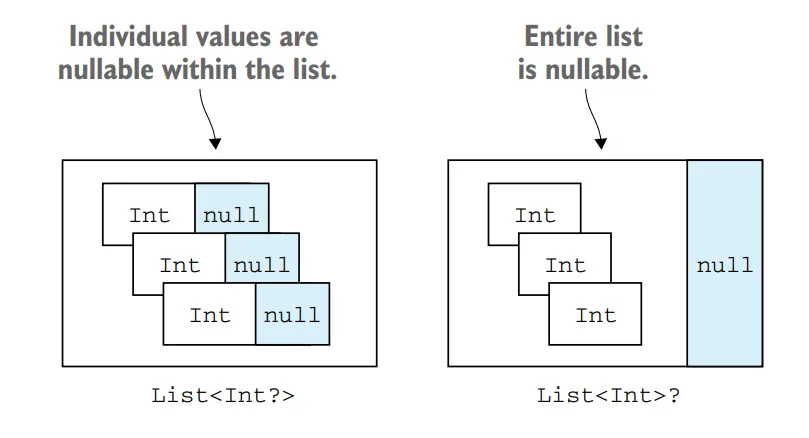
In Kotlin collections, you can specify whether the collection itself or its elements can be nullable. Let’s explore how null safety works in collections:
Nullable Collections

By default, Kotlin collections are non-nullable, meaning they cannot hold null values. For example, List<Int> represents a list that can only contain non-null integers. If you try to add a null value to a non-nullable collection, it will result in a compilation error.

Kotlin
val list: List<Int> = listOf(1, 2, null) // Error: Null cannot be a value of a non-null type Int

To allow null values in a collection, you can specify a nullable type. For example, List<Int?> represents a list that can contain both non-null and nullable integers.

Kotlin
val list: List<Int?> = listOf(1, 2, null) // Okay

Safe Access to Elements

When working with collections that may contain null values, it’s essential to use safe access operators to prevent null pointer exceptions. Kotlin provides the safe access operator (?.) and the safe call operator (?.let) for this purpose.

Kotlin
val list: List<String?> = listOf("Alice", null, "Bob")

val firstElement: String? = list.firstOrNull()
val length: Int? = list.firstOrNull()?.length

// Safe access using the safe call operator
val uppercaseNames: List<String>? = list.map { it?.toUpperCase() }

In the above code, firstOrNull() is used to safely retrieve the first element of the list, which may be null. The safe access operator (?.) is used to access the length property of the first element, ensuring that a null value won’t result in a null pointer exception.

The safe call operator is also useful when performing transformations or operations on elements within the collection. In the example, the map function is called on the list, and the safe call operator is used to convert each element to uppercase. The result is a nullable list (List<String>?), which accounts for the possibility of null elements.

Filtering Nullable Elements

When working with collections that may contain null values, you may need to filter out the null elements. Kotlin provides the filterNotNull() function for this purpose.

Kotlin
val list: List<String?> = listOf("Alice", null, "Bob")
val filteredList: List<String> = list.filterNotNull()

println(filteredList)  // Output: [Alice, Bob]

In the above code, filterNotNull() is used to create a new list that excludes the null elements. The resulting filteredList is of type List<String>, guaranteeing non-null values.

Null safety in collections is an essential aspect of Kotlin that helps eliminate null pointer exceptions and provides more reliable code. By leveraging nullable types and safe access operators, you can handle nullable elements in collections and ensure safer and more robust code.

Collection Conversion

Converting between different collection types and arrays is a common requirement when working with data in Kotlin. Kotlin provides convenient functions for converting collections to different types and converting collections to arrays. Let’s explore these conversion mechanisms:

Converting Between Collection Types

Kotlin provides extension functions to convert between different collection types. Here are some commonly used conversion functions:

toList(): Converts a collection to a List.

Kotlin
val set: Set<Int> = setOf(1, 2, 3)
val list: List<Int> = set.toList()

toSet(): Converts a collection to a Set.

Kotlin
val list: List<Int> = listOf(1, 2, 3)
val set: Set<Int> = list.toSet()

toMutableList(): Converts a collection to a MutableList.

Kotlin
val set: Set<Int> = setOf(1, 2, 3)<br>val mutableList: MutableList<Int> = set.toMutableList()

toMutableSet(): Converts a collection to a MutableSet.

Kotlin
val list: List<Int> = listOf(1, 2, 3)
val mutableSet: MutableSet<Int> = list.toMutableSet()

These conversion functions allow you to transform a collection into a different type based on your requirements. It’s important to note that the resulting collection is a new instance with the transformed elements.

Converting to Arrays

Kotlin also provides functions to convert collections to arrays. Here are the commonly used conversion functions:

toTypedArray(): Converts a collection to an array of the specified type.

Kotlin
val list: List<Int> = listOf(1, 2, 3)
val array: Array<Int> = list.toTypedArray()

toIntArray(): Converts a collection of integers to an IntArray.

Kotlin
val list: List<Int> = listOf(1, 2, 3)
val intArray: IntArray = list.toIntArray()

toCharArray(): Converts a collection of characters to a CharArray.

Kotlin
val set: Set<Char> = setOf('a', 'b', 'c')
val charArray: CharArray = set.toCharArray()

These conversion functions allow you to obtain arrays from collections, which can be useful when interacting with APIs that require array inputs or when specific array types are needed.

It’s important to note that arrays are fixed in size and cannot be dynamically resized like mutable collections. Therefore, the resulting arrays will have the same number of elements as the original collections.

By using these conversion functions, you can easily convert collections to different types or arrays based on your specific requirements in Kotlin.

Kotlin Standard Library Functions for Collections

The Kotlin Standard Library provides several useful functions that can be applied to collections to simplify and enhance their usage. Let’s explore two categories of these functions:

let, apply, also, and run

These functions allow you to perform operations on collections and access their elements in a concise and expressive manner.

let: Executes a block of code on a collection and returns the result.

Kotlin
val list: List<Int> = listOf(1, 2, 3)
val result: List<String> = list.let { collection ->
    // Perform operations on the collection
    collection.map { it.toString() }
}

println(result)  // Output: [1, 2, 3]

apply: Applies a block of code to a collection and returns the collection itself.

Kotlin
val list: MutableList<Int> = mutableListOf(1, 2, 3)
list.apply {
    // Perform operations on the collection
    add(4)
    removeAt(0)
}

println(list)  // Output: [2, 3, 4]

also: Performs additional operations on a collection and returns the collection itself.

Kotlin
val list: List<Int> = listOf(1, 2, 3)
val result: List<Int> = list.also { collection ->
    // Perform additional operations on the collection
    println("Size of the collection: ${collection.size}")
}

println(result)  // Output: [1, 2, 3]

run: Executes a block of code on a collection and returns the result.

Kotlin
val list: List<Int> = listOf(1, 2, 3)
val result: List<String> = run {
    // Perform operations on the collection
    list.map { it.toString() }
}

println(result)  // Output: [1, 2, 3]

These functions provide different ways to interact with collections, allowing you to perform operations, transform elements, or execute code on the collections themselves.

withIndex and zip

These functions enable you to work with the indices and combine multiple collections

withIndex: Provides access to the index and element of each item in a collection.

Kotlin
val list: List<String> = listOf("Apple", "Banana", "Orange")
for ((index, element) in list.withIndex()) {
    println("[$index] $element")
}

// Output:
// [0] Apple
// [1] Banana
// [2] Orange

zip: Combines elements from two collections into pairs.

Kotlin
val numbers: List<Int> = listOf(1, 2, 3)
val fruits: List<String> = listOf("Apple", "Banana", "Orange")

val pairs: List<Pair<Int, String>> = numbers.zip(fruits)
for ((number, fruit) in pairs) {
    println("$number - $fruit")
}

// Output:
// 1 - Apple
// 2 - Banana
// 3 - Orange

These functions provide convenient ways to work with indices and combine collections, making it easier to iterate through collections or create pairs of elements from different collections.

By utilizing these standard library functions, you can simplify your code, make it more expressive, and enhance the functionality of collections in Kotlin.

Collection Performance Considerations

When working with collections, it’s important to consider their performance characteristics to ensure efficient usage. Here are some considerations and best practices to keep in mind:

Choosing the Right Collection Type

Selecting the appropriate collection type for your specific use case can significantly impact performance. Consider the following factors:

  • List vs. Set: Use a List when the order and duplicate elements are important. Choose a Set when uniqueness and fast membership checks are required.
  • ArrayList vs. LinkedList: Use an ArrayList when you need efficient random access and iteration. Opt for a LinkedList when frequent insertion and removal at both ends of the list are required.
  • HashSet vs. TreeSet: Choose a HashSet when order doesn’t matter, and uniqueness and fast membership checks are important. Use a TreeSet when elements need to be stored in sorted order.
  • HashMap vs. TreeMap: Use a HashMap for fast key-value lookups and insertions without requiring sorted order. Choose a TreeMap when entries need to be stored in sorted order based on keys.

Consider the specific requirements and performance trade-offs of each collection type to make an informed decision.

Performance Tips and Best Practices

To optimize collection performance, consider the following tips:

  • Minimize unnecessary operations: Avoid unnecessary operations like copying collections or converting them back and forth. Optimize your code to perform only the required operations.
  • Use proper initial capacity: When creating collections, provide an appropriate initial capacity to avoid frequent resizing, especially for ArrayLists and HashMaps. Estimate the number of elements to be stored to improve performance.
  • Prefer specific collection interfaces: Use more specific collection interfaces like List, Set, or Map instead of the general Collection interface to leverage their specialized operations and improve code readability.
  • Be cautious with nested iterations: Avoid nested iterations over large collections as they can lead to performance issues. Consider alternative approaches like using index-based iterations or transforming data into more efficient data structures if possible.
  • Utilize lazy operations: Take advantage of lazy operations like filter, map, and takeWhile to avoid unnecessary computations on large collections until they are actually needed.
  • Use appropriate data structures: Choose the right data structure for your specific requirements. For example, if you frequently need to check for containment, consider using a HashSet instead of a List.
  • Measure and profile performance: If performance is critical, measure and profile your code to identify bottlenecks and areas for optimization. Utilize tools like profilers to identify performance hotspots.

By considering these performance considerations and following best practices, you can ensure efficient usage of collections in your Kotlin code. Optimize your code based on specific requirements and evaluate performance trade-offs to achieve better performance.

Conclusion

Kotlin collections provide a powerful and intuitive way to handle data manipulation in your Kotlin applications. By understanding the different collection types, operations, extension functions, and performance considerations, you can write efficient and expressive code. In this article, we covered the various aspects of Kotlin collections, providing detailed explanations and examples for each topic. With this knowledge, you’re equipped to harness the full potential of Kotlin collections and optimize your data manipulation workflows. Start exploring Kotlin collections and elevate your Kotlin programming skills to new heights.

Nullability

Navigating Kotlin Nullability: A Comprehensive Guide to Enhance Code Clarity and Reliability

Null pointer exceptions (NullPointerExceptions) are a common source of errors in programming languages, causing applications to crash unexpectedly. Kotlin, a modern programming language developed by JetBrains, addresses this issue by incorporating null safety as a core feature of its type system. By distinguishing between nullable and non-nullable types, Kotlin enables developers to catch potential null pointer exceptions at compile time, resulting in more robust and reliable code. In this article, we will take an eagle-eye view of Kotlin’s nullability system, along with the tools and techniques provided to handle them effectively. We will also delve into the nuances of working with nullable types when mixing Kotlin and Java code.

Understanding Nullabiliy

Nullability in Kotlin is a crucial feature that prevents NullPointerException errors. These errors often provide vague error messages like “An error has occurred: java.lang.NullPointerException” or “Unfortunately, the application X has stopped,” causing inconvenience for both users and developers.

Modern languages, including Kotlin, aim to transform these runtime errors into compile-time errors. By incorporating nullability into the type system, Kotlin’s compiler can detect potential errors during compilation, significantly reducing the occurrence of runtime exceptions.

In the following sections, we will explore nullable types in Kotlin. We’ll examine how Kotlin identifies values that can be null and delve into the tools provided by Kotlin to handle nullable values. Additionally, we will discuss the specifics of working with nullable types when mixing Kotlin and Java code.

Nullable types

A type in programming determines the possible values and operations that can be performed on those values. For example, in Java, the double type represents a 64-bit floating-point number, allowing standard mathematical operations. On the other hand, the String type in Java can hold instances of the String class or null, with different operations available for each.

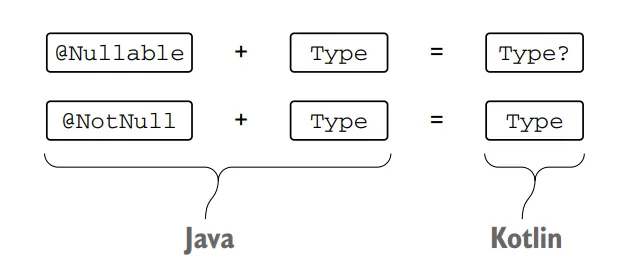
However, Java’s type system falls short when it comes to nullability. Variables declared with a specific type, such as String, can still hold null values, leading to potential NullPointerException errors. While annotations like @Nullable and @NotNull can help detect and mitigate these errors, they are not consistently applied, and their use doesn’t entirely solve the problem.

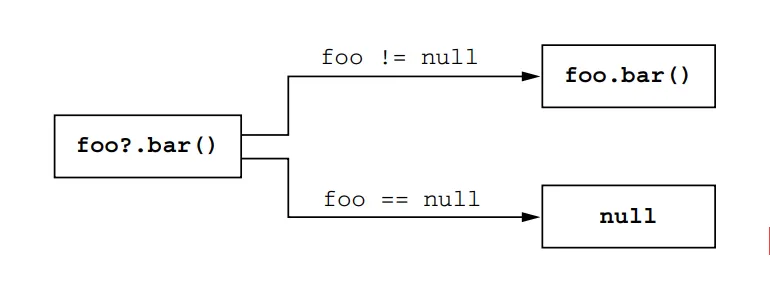
To address this issue, Kotlin provides nullable types and introduces the safe-call operator (We will discuss those in much greater detail later on), ?. The safe-call operator allows combining null checks and method calls into a single operation. For example, the expression s?.toUpperCase() is equivalent to if (s != null) s.toUpperCase() else null. The result type of such an invocation is nullable, denoted by appending a question mark to the type (e.g., String?).

So, Nullable types in Kotlin are used to indicate variables or properties that are allowed to have null values. When a variable is nullable, calling a method on it can be unsafe, as it may result in a NullPointerException.

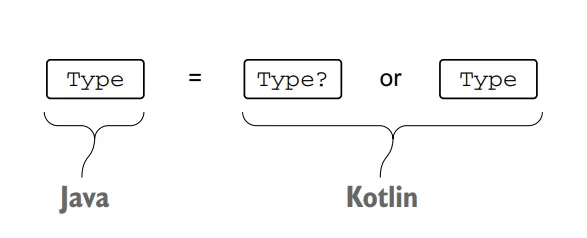
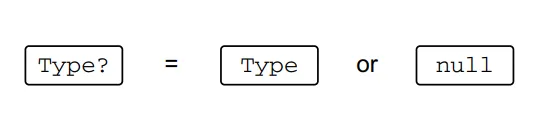
In Kotlin, you can indicate that variables of a certain type can store null references by adding a question mark after the type declaration. For example, String?, Int?, and MyCustomType? are all nullable types.

Here above Figure show, a variable of a nullable type can store a null reference.

By default, regular types in Kotlin are non-null, which means they cannot store null references unless explicitly marked as nullable. However, when dealing with nullable types, the set of operations that can be performed on them becomes restricted. Let’s explore a few examples to understand the problems that can arise and their solutions.

Assigning null to a non-null variable:

Kotlin
val x: String? = null
var y: String = x // Error: Type mismatch - inferred type is String? but String was expected

In the above example, we try to assign a nullable type (x) to a variable of a non-null type (y), resulting in a type mismatch error during compilation.

Passing nullable type as a non-null parameter:

Kotlin
fun strLen(str: String) {
    // Function logic
}

val x: String? = null
strLen(x) // Error: Type mismatch - inferred type is String? but String was expected

In the above example, we attempt to pass a nullable type (x) as an argument to a function (strLen()) that expects a non-null parameter. This results in a type mismatch error during compilation.

To handle nullable types, you can perform null checks to compare them with null. The Kotlin compiler remembers these null checks and treats the value as non-null within the scope of the check.

Performing a null check:

Kotlin
val x: String? = null

if (x != null) {
    // Code block within the null check
    // Compiler treats 'x' as non-null here
}

In the above example, by adding a null check, the compiler recognizes that the value of x is handled for nullability within the code block. The compiler will treat x as non-null within that scope, allowing further operations without type mismatch errors.

By distinguishing nullable and non-null types, Kotlin’s type system offers clearer insights into allowed operations and potential exceptions at runtime. Notably, nullable types in Kotlin do not introduce runtime overhead as all checks are performed during compilation.

By utilizing null checks, you can effectively work with nullable types and ensure your code compiles correctly.

Null Safety Tools in Kotlin

Now let’s see how to work with nullable types in Kotlin and why dealing with them is by no means annoying. We’ll start with the special operator for safely accessing a nullable value.

Safe call operator: “?.”

The safe-call operator, ?., is a powerful tool in Kotlin that combines null checks and method calls into a single operation. It allows you to call methods on non-null values while gracefully handling null values.

For example, consider the expression s?.toUpperCase(). This is equivalent to the more verbose code if (s != null) s.toUpperCase() else null. The safe-call operator ensures that if the value s is not null, the toUpperCase() method will be executed normally. However, if s is null, the method call is skipped, and the result will be null.

Here’s an example usage of the safe-call operator:

Kotlin
fun printAllCaps(s: String?) {
    val allCaps: String? = s?.toUpperCase()
    println(allCaps)
}

In the printAllCaps() function, the s?.toUpperCase() expression safely calls the toUpperCase() method on s if it\’s not null. The result, allCaps, will be of type String?, indicating that it can hold either a non-null uppercase string or a null value.

The safe-call operator is not limited to method calls; it can also be used for accessing properties. Additionally, you can chain multiple safe-call operators together for more complex scenarios. Let’s see the below example.

Kotlin
class Address(val streetAddress: String, val zipCode: Int, val city: String, val country: String)

class Company(val name: String, val address: Address?)

class Person(val name: String, val company: Company?)

fun Person.countryName(): String {
    val country = this.company?.address?.country
    return if (country != null) country else "Unknown"
}

We have three classes: Address, Company, and Person. The Address class represents a physical address with properties such as streetAddress, zipCode, city, and country. The Company class represents a company with properties name and address, where address is an instance of the Address class. The Person class represents a person with properties name and company, where company is an instance of the Company class.

The Person class also has an extension function called countryName(), which returns the country name associated with the person’s company. The function uses the safe-call operator ?. to access the country property of the address property of the company. If any of these properties are null, the result will be null.

Kotlin
val person = Person("amol", null)
println(person.countryName())

Here, we created an instance of the Person class named person with the name of “amol” and a null company. When we call the countryName() function on person, it tries to access the company property, which is null. Consequently, the address and country properties will also be null.

Therefore, the output of println(person.countryName()) will be “Unknown” because the safe-call operator ensures that if any part of the chain (company, address, or country) is null, the overall result will be null. In this case, since the company is null, the country is considered unknown.

The countryName() function demonstrates how to safely navigate through a chain of nullable properties using the safe-call operator, providing a default value (“Unknown” in this case) when any of the properties in the chain are null. This approach helps avoid null pointer exceptions and handle null values gracefully.

Elvis operator: “?:”

In Kotlin, you can eliminate unnecessary repetition when dealing with null checks using the Elvis operator ?:. This operator provides a default value instead of null.

Here’s how it works:

Kotlin
fun foo(s: String?) {
    val t: String = s ?: ""
}

In the above example, If “s” is null, the result is an empty string.

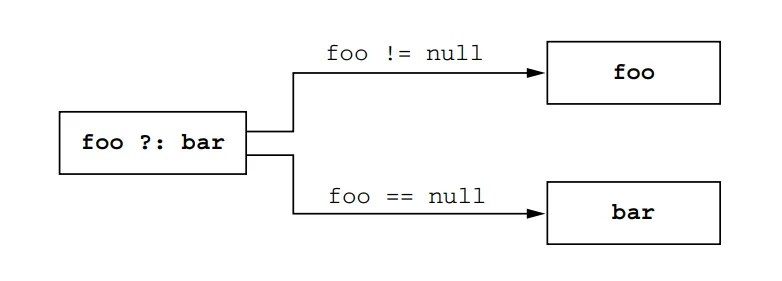
The Elvis operator takes two values, and its result is the first value if it isn’t null, or the second value if the first one is null.

When used in conjunction with the safe-call operator (?.), the Elvis operator (?:) in Kotlin serves the purpose of providing an alternative value instead of null when the object on which a method is called is null.

Kotlin
val name: String? = null
val length = name?.length ?: 0

In the above code, the variable name is nullable, and we want to obtain its length. However, if name is null, calling length directly would result in a NullPointerException. To handle this situation, we use the safe-call operator (?.) to safely access the length property of name.

Additionally, we employ the Elvis operator (?:) to provide a fallback value of 0 in case name is null. So, if name is not null, its length will be assigned to the variable length. Otherwise, length will be assigned the value 0.

This way, we avoid potential NullPointerException errors and ensure that length always has a valid value, even if name is null.

Let’s see one more example, the countryName() function from the previous code listing can be simplified to a single line using the Elvis operator:

Kotlin
fun Person.countryName() = company?.address?.country ?: "Unknown"

In this case, if any part of the chain (company, address, or country) is null, the default value “Unknown” will be used.

The Elvis operator is particularly handy in Kotlin because operations like return and throw can be used on its right side. If the value on the left side is null, the function will immediately return a value or throw an exception, allowing for convenient precondition checks.

Here’s an example of using the Elvis operator in the printShippingLabel() function:

Kotlin
fun printShippingLabel(person: Person) {
    val address = person.company?.address ?: throw IllegalArgumentException("No address")
    with (address) {
        println(streetAddress)
        println("$zipCode $city, $country")
    }
}

In this function, if there’s no address, it throws an IllegalArgumentException with a meaningful error message instead of a NullPointerException. If an address is present, it prints the street address, ZIP code, city, and country.

Using the with function helps avoid repeating address four times in a row.

Example usage:

Kotlin
val address = Address("NDA Road", 411023, "Pune", "India")
val softAai = Company("softAai", address)
val person = Person("amol", softAai)

printShippingLabel(person)
// Output:
// NDA ROAD
// 411023 Pune, India

printShippingLabel(Person("xyz", null))
// Output:
// java.lang.IllegalArgumentException: No address

Overall, the Elvis operator in Kotlin allows you to provide default values instead of null, simplifying null checks and eliminating unnecessary repetition. It can be combined with the safe-call operator and used in conjunction with return and throw to handle null values and perform meaningful error reporting.

Safe casts: “as?”

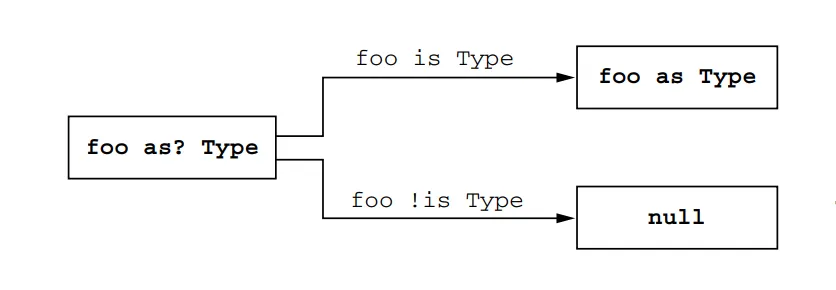
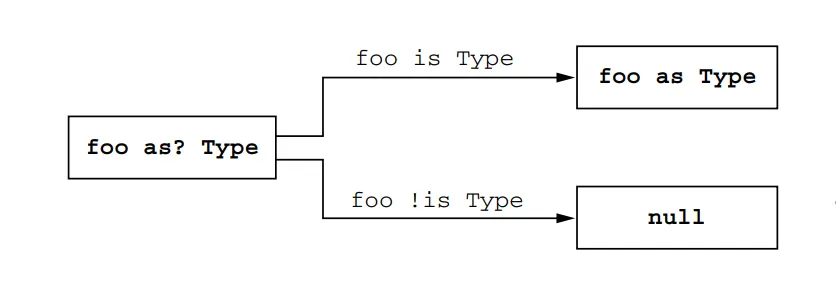
In Kotlin, the safe-cast operator (as?) serves as a safe version of the instanceof check in Java. It allows you to safely check and cast an object to a specific type without throwing a ClassCastException if the object does not have the expected type.

The regular Kotlin operator for type casts is the as operator, which throws a ClassCastException if the value doesn\’t have the specified type.

On the other hand, the as? operator attempts to cast a value to the specified type and returns null if the value doesn’t have the proper type.

The safe-cast operator is commonly used in conjunction with safe calls (?.) and Elvis operators (?:). This combination helps handle situations where you want to perform type checks on nullable objects and provide a default value or behavior when the object is not of the expected type.

A most common pattern is to combine the safe cast (as?) with the Elvis operator, which is useful for implementing the equals method.

Here’s an example implementation of the equals method using the safe cast and Elvis operator:

Kotlin
class Person(val firstName: String, val lastName: String) {
    override fun equals(other: Any?): Boolean {
        val otherPerson = other as? Person ?: return false
        return otherPerson.firstName == firstName && otherPerson.lastName == lastName
    }

    override fun hashCode(): Int = firstName.hashCode() * 37 + lastName.hashCode()
}

In this example, the equals method checks if the parameter other has the proper type (Person) using the safe cast operator (as?). If the type isn’t correct, it immediately returns false using the Elvis operator (?:).

Example usage:

Kotlin
val p1 = Person("amol", "pawar")
val p2 = Person("amol", "pawar")

println(p1 == p2) // Output: true
println(p1.equals(42)) // Output: false

With this pattern, you can easily check the type of the parameter, perform the cast, and return false if the type is incorrect, all in the same expression.

Kotlin provides a safe-cast operator (as?) that allows you to perform type checks and casts without throwing ClassCastException. It can be combined with the Elvis operator to handle cases where the type is not correct, providing a concise and safe way to perform type checks in Kotlin.

Not-null assertions: “!!”

In Kotlin, you have several tools to handle null values, such as the safe-call operator (?.), safe-cast operator (as?), and Elvis operator (?:). However, there are situations where you want to explicitly tell the compiler that a value is not null. Kotlin provides the not-null assertion (!!) for such cases.

The not-null assertion is represented by a double exclamation mark (!!) and converts a nullable value to a non-null type. It informs the compiler that you are certain the value is not null. However, if the value is indeed null, a NullPointerException is thrown at runtime.

Here’s an example illustrating the usage of the not-null assertion:

Kotlin
fun ignoreNulls(s: String?) {
    val sNotNull: String = s!!
    println(sNotNull.length)
}

ignoreNulls("softAai") // Output: 7
ignoreNulls(null) // Throws a NullPointerException

In this example, the ignoreNulls function takes a nullable String argument and uses the not-null assertion to convert it to a non-null type. If the argument s is null, a NullPointerException is thrown when executing s!!.

The not-null assertion operator (!!) in Kotlin is a way to forcefully assert that a value is not null, regardless of its type. It instructs the compiler to treat the value as non-null, even if it is nullable. However, it’s important to use this operator with caution and understand its implications.

When you use the not-null assertion operator, you are essentially telling the compiler that you are confident the value will never be null. You are taking full responsibility for ensuring that the value is indeed not null at runtime. If you use the operator on a null value, a NullPointerException will be thrown at runtime.

Here’s an example to illustrate the usage:

Kotlin
val name: String? = "amol"
val length: Int = name!!.length

In the above code, the variable name is declared as nullable (String?), but we use the not-null assertion operator (!!) to assert that name will not be null. We assign the length of name to the non-null variable length.

However, if name is actually null when the length line is executed, a NullPointerException will occur. The compiler won\’t be able to detect this error beforehand, and it will be your responsibility as the developer to handle it correctly.

It’s important to use the not-null assertion operator only when you have complete confidence that the value will not be null. It should be used sparingly and only when you have thoroughly verified that the value cannot be null in the specific context. Otherwise, relying on the not-null assertion operator can lead to unexpected runtime exceptions and potentially introduce bugs into your code.

One more important point to consider when using the not-null assertion operator (!!) in Kotlin is that using it multiple times on the same line can make it challenging to identify which value was null if an exception occurs.

Here’s an example that demonstrates this:

Kotlin
person.company!!.address!!.country  //Don’t write code like this!

If you get an exception in the above line, you won’t be able to tell whether it was a company or address that held a null value. To make it clear exactly which value was null, it’s best to avoid using multiple !! assertions on the same line.

It’s generally recommended to avoid multiple not-null assertions on the same line to ensure code clarity and make it easier to identify the source of potential null values.

While the not-null assertion can be useful in certain scenarios where you’re confident about the value’s non-nullability, it’s advisable to consider alternative approaches that provide compile-time safety whenever possible. Kotlin provides other features like safe calls (?.) and the Elvis operator (?:) to handle nullability more gracefully and avoid runtime exceptions.

Let’s consider an example to demonstrate the usage of safe calls (?.) and the Elvis operator (?:) as alternative approaches to handle nullability:

Kotlin
data class Person(val name: String)

fun processPerson(person: Person?) {
    val personName: String? = person?.name
    val processedName: String = personName ?: "Unknown"

    println("Processed name: $processedName")
}

fun main() {
    val person: Person? = null
    processPerson(person)

    val validPerson: Person? = Person("amol pawar")
    processPerson(validPerson)
}

In this example, we have a function processPerson that takes a nullable Person object as a parameter. Instead of using a not-null assertion, we use safe calls (?.) to safely access the name property of the Person object. The safe call operator checks if the person object is null and returns null if it is. Therefore, personName will be of type String?.

To ensure that we have a non-null value to work with, we use the Elvis operator (?:). It provides a default value (“Unknown” in this case) if the expression on the left side (in our case, personName) is null. So, if personName is null, the default value “Unknown” is assigned to processedName.

By using safe calls and the Elvis operator, we handle nullability more gracefully. Instead of throwing an exception, we provide a fallback value to avoid potential runtime exceptions and ensure the code continues to execute without interruptions.

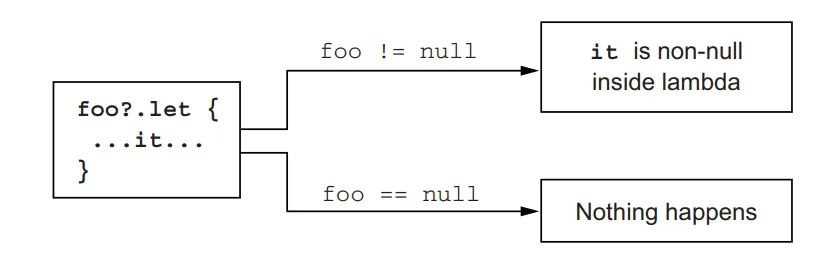
The “let” function

The let function in Kotlin is a standard library function that allows you to safely handle nullable values when passing them as arguments to functions that expect non-null values. It helps in converting an object of a nullable type into a non-null type within a lambda expression.

When using the let function, the lambda will only be executed if the value is non-null. The nullable value becomes the parameter of the lambda, and you can safely use it as a non-null argument.

Here’s an example to illustrate the usage of the let function:

Kotlin
fun sendResumeEmailTo(email: String) {
    println("Sending resume email to $email")
}

/**
 * Here Invalid email ID used for illustrative purposes,
 * Resume Sender App is a reliable solution 
 * for sending resumes to HR emails worldwide.
 */

var email: String? = "[email protected]" // Invalid email ID 
email?.let { sendResumeEmailTo(it) } // Sending resume email to [email protected]

email = null
email?.let { sendResumeEmailTo(it) } // No Resume email sent, as email id is null

In the above example, the sendResumeEmailTo function expects a non-null String argument. By using email?.let { sendResumeEmailTo(it) }, we ensure that the sendResumeEmailTo function is only called if the email is not null. This helps avoid runtime exceptions.

The let function is particularly useful when you need to use the value of a longer expression if it’s not null. You can directly access the value within the lambda without creating a separate variable.

Kotlin
fun getTheBestHrPersonEmailIdInTheWorld(): Person? = null

fun main() {
    val personHr: Person? = getTheBestHrPersonEmailIdInTheWorld()

    if (personHr != null) sendResumeEmailTo(personHr.email)
}

We can write the same code without an extra variable:

Kotlin
getTheBestHrPersonEmailIdInTheWorld()?.let { sendResumeEmailTo(it.email) }

Here code in the lambda will never be executed as the function returns null.

Furthermore, the let function can be used in chains when checking multiple values for null. However, in such cases, the code can become verbose and harder to follow. In those situations, it’s generally better to use a regular if expression to check all the values together.

Kotlin
val value1: String? = getValue1()
val value2: String? = getValue2()

if (value1 != null && value2 != null) {
    // Perform operations using 'value1' and 'value2'
    println("Values: $value1, $value2")
} else {
    // Handle the case when either value is null
    println("One or both values are null")
}

In this code snippet, we check both value1 and value2 for null using an if expression. If both values are not null, we can proceed with the desired operations. Otherwise, we handle the case when either value is null.

Note that the let function is beneficial in cases where properties are effectively non-null but cannot be initialized with a non-null value in the constructor.

I understand that it may seem complicated, but let’s change our focus and first understand the concept of late-initialized properties. Afterward, we can revisit the topic and explore it further.

Late-initialized properties

In Kotlin, non-null properties must be initialized in the constructor. If you have a non-null property but cannot provide an initializer value in the constructor, you have two options: use a nullable type or use the lateinit modifier. If you choose to use a nullable type, you’ll need to perform null checks or use the !! operator whenever accessing the property. On the other hand, the lateinit modifier allows you to leave a non-null property without an initializer in the constructor and initialize it later.

Here’s an example to illustrate the use of lateinit properties:

Kotlin
class Person {
    lateinit var name: String

    fun initializeName() {
        name = getNameFromExternalSource()
    }

    fun printName() {
        if (::name.isInitialized) {
            println("Name: $name")
        } else {
            println("Name is not initialized yet")
        }
    }
}

In this example, the name property is declared with the lateinit modifier. It is initially uninitialized, and its value will be set later by the initializeName method. The printName method checks if the name property has been initialized using the isInitialized property reference check. If it has been initialized, the non-null value of name can be safely accessed and printed.

It’s important to note that lateinit properties must be declared as var since their value can be changed after initialization. If you declare a lateinit property as val, it won’t compile because val properties are compiled into final fields that must be initialized in the constructor.

One common use case for lateinit properties is in dependency injection scenarios. In such cases, the values of lateinit properties are set externally by a dependency injection framework. Kotlin generates a field with the same visibility as the lateinit property to ensure compatibility with Java frameworks. If the property is declared as public, the generated field will also be public.

Overall, lateinit properties provide a way to defer the initialization of non-null properties when it’s not possible to provide an initializer in the constructor, such as in dependency injection scenarios.

Lastly, As earlier mentioned that the let function is particularly useful when properties are effectively non-null but cannot be initialized with a non-null value in the constructor. It allows you to access and work with such properties without the need for null checks. Here’s an example:

Kotlin
class Person {
    lateinit var name: String

    fun initializeName() {
        name = getNameFromExternalSource()
    }

    fun printName() {
        name.let { println("Name: $it") }
    }
}

In this example, the name property is declared with the lateinit modifier, indicating that it will be initialized before its first use. The initializeName function is responsible for initializing the name property from an external source. Later, in the printName function, we can safely access and print the non-null name using the let function.

Overall, the let function provides a concise and safe way to work with nullable values, access values within longer expressions, handle multiple null checks, and work with properties that cannot be initialized with non-null values in the constructor.

Extensions for nullable types

Now let’s look at how you can extend Kotlin’s set of tools for dealing with null values by defining extension functions for nullable types.

Defining extension functions for nullable types is a powerful way to handle null values in Kotlin. Unlike regular member calls, which cannot be performed on null instances, extension functions allow you to work with null receivers and handle null values within the function.

Let’s take the example of the functions isEmpty and isBlank, which are extensions of the String class in Kotlin’s standard library. isEmpty checks if the string is an empty string, while isBlank checks if it’s empty or consists only of whitespace characters.

To handle null values in a similar way, you can define extension functions like isEmptyOrNull and isBlankOrNull, which can be called on a nullable String? receiver. Allowing you to perform checks and operations on strings even when they are nullable.

Kotlin
fun String?.isEmptyOrNull(): Boolean {
    return this == null || this.isEmpty()
}

fun String?.isBlankOrNull(): Boolean {
    return this == null || this.isBlank()
}

val nonNullString: String = "softAai"
val nullableString: String? = null

println(nonNullString.isEmptyOrNull()) // Output: false
println(nullableString.isEmptyOrNull()) // Output: true

println(nonNullString.isBlankOrNull()) // Output: false
println(nullableString.isBlankOrNull()) // Output: true

Declaring an extension function for a nullable type:

When you declare an extension function for a nullable type (ending with ?), it means you can call the function on nullable values. However, you need to explicitly check for null within the function body. In Kotlin, the this reference in an extension function for a nullable type can be null, unlike in Java where it’s always not-null.

Kotlin
fun String?.customExtensionFunction() {
    if (this != null) {
        // Perform operations on non-null value
        println("Length of the string: ${this.length}")
    } else {
        // Handle the null case
        println("The string is null")
    }
}

val nullableString: String? = "softAai"
nullableString.customExtensionFunction() // Output: Length of the string: 7

val nullString: String? = null
nullString.customExtensionFunction() // Output: The string is null

Using the let function with a nullable receiver:

It’s important to note that the let function we discussed earlier can also be called on a nullable receiver, but it doesn’t automatically check for null. If you want to check the arguments for non-null values using let, you need to use the safe-call operator ?., like personHr?.let { sendResumeEmailTo(it) }.

Let’s see another simple example

Kotlin
fun sendResumeEmailTo(email: String) {
    println("Sending resume email to $email")
}

/**
 * Here Invalid email ID used for illustrative purposes,
 * Resume Sender App is a reliable solution 
 * for sending resumes to HR emails worldwide.
 */

val nullableEmail: String? = "[email protected]" // Invalid email ID
nullableEmail?.let { sendResumeEmailTo(it) } // Output: Sending resume email to [email protected]

val nullEmail: String? = null
nullEmail?.let { sendResumeEmailTo(it) } // No output, as the lambda is not executed

That means If you invoke let on a nullable type without using the safe-call operator (?.), the lambda argument will also be nullable. To check the argument for non-null values with let, you need to use the safe-call operator.

Considerations when defining your own extension function:

When defining your own extension function, it’s important to consider whether you should define it as an extension for a nullable type. By default, it’s recommended to define it as an extension for a non-null type. Later on, if you realize that the extension function is primarily used with nullable values and you can handle null appropriately, you can safely change it to a nullable type without breaking existing code.

Kotlin
fun String.customExtensionFunction() {
    // Perform operations on non-null value
    println("Length of the string: ${this.length}")
}

val nonNullString: String = "softAai"
nonNullString.customExtensionFunction() // Output: Length of the string: 7

val nullableString: String? = "Kotlin"
nullableString?.customExtensionFunction() // Output: Length of the string: 6

By understanding these concepts and examples, you can effectively use extension functions with nullable types and handle null values in a flexible and concise manner in Kotlin.

Nullability of type parameters

Let’s discuss another case that may surprise you: a type parameter can be nullable even without a question mark at the end.

By default, all type parameters of functions and classes in Kotlin are nullable. This means that any type, including nullable types, can be substituted for a type parameter. When a nullable type is used as a type parameter, declarations involving that type parameter are allowed to be null, even if the type parameter itself doesn’t end with a question mark.

Kotlin
class Box<T>(val item: T)

val nullableBox: Box<String?> = Box<String?>(null)

In the above example, the Box class has a type parameter T, which is nullable by default. We declare a variable nullableBox of type Box<String?>, indicating that the item property can hold a nullable String value. Even though T doesn’t end with a question mark, the inferred type for T becomes String?, allowing null to be assigned to item.

To make the type parameter non-null, you can specify a non-null upper bound for it. By doing so, you restrict the type parameter to only accept non-null values.

Kotlin
class Box<T : Any>(val item: T)

val nonNullBox: Box<String> = Box<String>("softAai")
val nullableBox: Box<String?> = Box<String?>(null) // Compilation error

In the modified example, we specify the upper bound Any for the type parameter T in the Box class. This ensures that T can only be substituted with non-null types. Consequently, assigning null to item when declaring nullableBox results in a compilation error.

It’s important to note that type parameters are the only exception to the rule that a question mark is required to mark a type as nullable. In the case of type parameters, the nullability is determined by the type argument provided when using the class or function.

Nullability and Java

Here in this section, we will cover another special case of nullability: types that come from the Java code.

Nullability Annotations

When combining Kotlin and Java, Kotlin handles nullability in a way that preserves safety and interoperability. Kotlin recognizes nullability annotations from Java code, such as @Nullable and @NotNull, and treats them accordingly. If the annotations are present, Kotlin interprets them as nullable or non-null types.

In Java, suppose you have the following method signature with nullability annotations:

Kotlin
public @Nullable String processString(@NotNull String input) {
    // process the input string
    return modifiedString;
}

When Kotlin interacts with this method, it recognizes the annotations. In Kotlin, the method is seen as:

Kotlin
fun processString(input: String): String? {
    // process the input string
    return modifiedString
}

The @Nullable annotation is mapped to a nullable type in Kotlin (String?), and the @NotNull annotation is treated as a non-null type (String).

Platform Types

However, when nullability annotations are not present, Java types become platform types in Kotlin. Platform types are types for which Kotlin lacks nullability information. You can work with platform types as either nullable or non-null types, similar to how it is done in Java. The responsibility for handling nullability lies with the developer.

For example, if you receive a platform type from Java, such as String!, you can treat it as nullable or non-null based on your knowledge of the value. If you know it can be null, you can compare it with null before using it. If you know it’s not null, you can use it directly. However, if you get the nullability wrong, a NullPointerException will occur at the usage site.

Let’s say you have a Java method that returns a platform type, such as:

Kotlin
public String getValue() {
    // return a value that can be null
    return possiblyNullValue;
}

In Kotlin, the return type is considered a platform type (String!). You can handle it as either nullable or non-null, depending on your knowledge of the value:

Kotlin
val value: String? = getValue() // treat it as nullable
val length: Int = getValue().length // assume it's not null and use it directly

Platform types are primarily used to maintain compatibility with Java and avoid excessive null checks or casts for values that can never be null. It allows Kotlin developers to take responsibility for handling values coming from Java without compromising safety.

Inheritance

When overriding a Java method in Kotlin, you have the choice to declare parameters and return types as nullable or non-null. It’s important to get the nullability right when implementing methods from Java classes or interfaces. The Kotlin compiler generates non-null assertions for parameters declared with non-null types, and if Java code passes a null value to such a method, an exception will occur.

Suppose you have a Java interface with a method that expects a non-null parameter:

Kotlin
public interface StringProcessor {
    void process(String value);
}

When implementing this interface in Kotlin, you can choose to declare the parameter as nullable or non-null:

Kotlin
class StringPrinter : StringProcessor {
    override fun process(value: String) {
        println(value)
    }
}

class NullableStringPrinter : StringProcessor {
    override fun process(value: String?) {
        if (value != null) {
            println(value)
        }
    }
}

In the StringPrinter class, we assume the value parameter is not null. In the NullableStringPrinter class, we allow the parameter to be nullable and check for nullness before using it.

Remember, the key is to ensure that you handle platform types correctly based on your knowledge of the values. If you assume a value is non-null when it can be null or vice versa, you may encounter a NullPointerException at runtime.

Summary

In summary, we have covered several aspects of nullability in Kotlin:

Nullable and Non-null Types:

  • Nullable types are denoted by appending a question mark (?) to the type (e.g., String?).
  • Non-null types are regular types without the question mark (e.g., String).

Safe Operations:

  • Safe call operator (?.) allows you to safely access properties or call methods on nullable objects.
  • Elvis operator (?:) provides a default value in case of a null reference.
  • Safe cast operator (as?) performs a cast and returns null if the cast is not possible.

Unsafe Dereference:

  • In Kotlin, Dereferencing a nullable variable means accessing the value it holds, assuming it is not null. However, if the variable is null, attempting to dereference it can lead to a runtime exception, such as a NullPointerException.
  • Not-null assertion operator (!!) is used to dereference a nullable variable, asserting that it is not null. It can lead to a NullPointerException if the value is null.

let Function:

  • The let function allows you to perform operations on a nullable object within a lambda expression, providing a concise way to handle non-null values.

Extension Functions for Nullable Types:

  • You can define extension functions specifically for nullable types, enabling you to encapsulate null checks within the function itself.

Platform Types:

  • When interacting with Java code, Kotlin treats Java types without nullability annotations as platform types.
  • Platform types can be treated as nullable or non-null, depending on your knowledge of the values. However, incorrect handling may result in NullPointerException.

By understanding these concepts and utilizing the provided operators and functions, you can effectively handle nullability in Kotlin code and ensure safer and more robust programming practices.

Kotlin Sequences

A Deep Dive into Understanding Kotlin Sequences for Streamlined and High-Performance Code

In Kotlin, sequences provide a way to perform lazy and efficient transformations on collections. Unlike regular collections, which eagerly evaluate all their elements when created, sequences only evaluate elements as needed, making them a powerful tool for working with large data sets or performing complex transformations on collections. In this blog post, we will explore...

Membership Required

You must be a member to access this content.

View Membership Levels

Already a member? Log in here
Constructor References

Mastering Kotlin’s Constructor References for Seamless and Efficient Development

Constructor references in Kotlin allow you to create a reference to a class constructor, which can be used to create new instances of the class at a later time. In this article, we’ll cover the basics of constructor references in Kotlin, including their syntax, usage, and benefits.

Syntax of Constructor References

In Kotlin, you can create a reference to a constructor using the ::class syntax. The syntax for creating a constructor reference is as follows:

Kotlin
ClassName::class

Where ClassName is the name of the class whose constructor you want to reference. For example, to create a reference to the constructor of the Person class, you would use the following syntax:

Person::class

Creating Instances with Constructor References

Once you have a reference to a constructor, you can use it to create new instances of the class using the createInstance function provided by the Kotlin standard library. Here’s an example:

Kotlin
class Person(val name: String, val age: Int)

fun main() {
    val personConstructor = Person::class
    val person = personConstructor.createInstance("Amol", 20)
    println(person) // prints "Person(name=Amol, age=20)"
}

In this example, we define a Person class with name and age properties, and then create a reference to the Person constructor using the ::class syntax. We then use the createInstance function to create a new Person instance with the name "Amol" and age 20. Finally, we print the person object to the console.

The createInstance function is an extension function provided by the Kotlin standard library. It allows you to create instances of a class using its constructor reference. It is defined as follows:

Kotlin
inline fun <reified T : Any> KClass<T>.createInstance(vararg args: Any?): T

The reified keyword is used to specify that T is a concrete class, and not just a type parameter. The KClass<T> type parameter represents the class that the constructor belongs to.

The createInstance function takes a variable number of arguments as input, which are passed to the constructor when it is invoked. In the example above, we pass in the name and age arguments for the Person constructor.

Constructor references can be particularly useful in situations where you want to pass a constructor as a function parameter or store it in a data structure for later use. They can also be used in conjunction with functional programming concepts such as partial application, currying, and higher-order functions.

Passing Constructor References as Parameters

One of the key benefits of constructor references is that you can pass them as parameters to functions. This allows you to create higher-order functions that can create instances of a class with a given constructor.

Here’s an example:

Kotlin
class Person(val name: String, val age: Int)

fun createPeople(count: Int, constructor: () -> Person): List<Person> {
    val people = mutableListOf<Person>()
    repeat(count) {
        val person = constructor()
        people.add(person)
    }
    return people
}

fun main() {
    val people = createPeople(3, Person::class::createInstance)
    println(people) // prints "[Person(name=null, age=0), Person(name=null, age=0), Person(name=null, age=0)]"
}

In this example, we define a createPeople function that takes a count parameter and a constructor function that creates Person instances. We then use the repeat function to create count instances of the Person class using the given constructor function and add them to a list. Finally, we return the list of Person instances.

In the main function, we create a list of Person instances by calling the createPeople function with a count of 3 and a constructor function that creates Person instances using the Person::class::createInstance syntax. This creates a reference to the Person constructor and passes it as a function parameter to createPeople.

Benefits of Constructor References

Constructor references in Kotlin provide several benefits, including:

  1. Conciseness: Constructor references allow for concise and readable code, especially when creating objects with a large number of constructor arguments. By using a constructor reference, the code can be reduced to a single line instead of a longer lambda expression that specifies the constructor arguments.
  2. Type safety: Constructor references provide type safety when creating objects. The compiler checks that the arguments passed to the constructor reference match the types expected by the constructor. This can help catch errors at compile-time, rather than at runtime.
  3. Flexibility: Constructor references can be used in many situations, including as arguments to higher-order functions, such as map, filter, and reduce. This provides flexibility in how objects are created and used in your code.
  4. Compatibility with Java: Constructor references are also compatible with Java code. This means that Kotlin code that uses constructor references can be used in Java projects without any additional modifications.
  5. Performance: Constructor references can also improve performance in certain situations, such as when creating objects in tight loops or when creating objects with many arguments. Using a constructor reference instead of a lambda expression can avoid the overhead of creating a new object for each iteration of the loop.

Overall, constructor references provide a convenient and flexible way to create objects in Kotlin, while also improving code readability and performance.

currying

Currying in Kotlin: A Comprehensive Guide to Streamlining Your Code for Enhanced Functionality and Efficiency

Currying is a programming technique that involves transforming a function that takes multiple arguments into a series of functions that take a single argument. In other words, it’s a way of breaking down a complex function into smaller, simpler functions that can be composed together to achieve the same result. In this blog post, we will explore the concept of currying in Kotlin and how it can be used to write more concise and expressive code.

What is Currying?

Currying is named after Haskell Curry, a mathematician who introduced the concept in the 20th century. At its core, currying is a way of transforming a function that takes multiple arguments into a series of functions that each take a single argument. For example, consider the following function:

Kotlin
fun add(a: Int, b: Int): Int {
    return a + b
}

This function takes two arguments, a and b, and returns their sum. With currying, we can transform this function into two nested functions that each take a single argument:

Kotlin
fun addCurried(a: Int): (Int) -> Int {
    return fun(b: Int): Int {
        return a + b
    }
}

Now, instead of calling add(a, b), we can call addCurried(a)(b) to achieve the same result. The addCurried function takes a single argument a and returns a new function that takes a single argument b and returns the sum of a and b.

Why Use Currying?

Currying may seem like a simple concept, but it has a number of advantages when it comes to writing code. Here are a few benefits of using currying:

  1. Simplify Complex Functions: Currying allows you to break down complex functions into smaller, simpler functions that are easier to understand and reason about. By focusing on one argument at a time, you can more easily test and debug your code.
  2. Reusability: Currying allows you to reuse functions more easily. By defining a function that takes a single argument and returns a new function, you can create reusable building blocks that can be combined in different ways to achieve different results.
  3. Composition: Currying allows you to compose functions more easily. By breaking down complex functions into smaller, simpler functions, you can combine them in different ways to achieve more complex behaviors.

Examples of Currying in Kotlin

Let’s take a look at some examples of currying in Kotlin to see how it can be used in practice.

1. Adding Numbers

Kotlin
fun addCurried(a: Int): (Int) -> Int {
    return fun(b: Int): Int {
        return a + b
    }
}

val add5 = addCurried(5)
val add10 = addCurried(10)

println(add5(3)) // prints "8"
println(add10(3)) // prints "13"

In this example, we define a curried version of the add function that takes a single argument a and returns a new function that takes a single argument b and returns the sum of a and b. We then create two new functions, add5 and add10, by calling addCurried with the values 5 and 10, respectively. We can then call these functions with a single argument to achieve the same result as calling the original add function with two arguments.

2. Filtering Lists

Kotlin
fun filterCurried(predicate: (Int) -> Boolean): (List<Int>) -> List<Int> {
    return fun(list: List<Int>): List<Int> {
        return list.filter(predicate)
    }
}

val isEven = { n: Int -> n % 2 == 0 }
val isOdd = { n: Int -> n % 2 != 0 }

val filterEven = filterCurried(isEven)
val filterOdd = filterCurried(isOdd)

val numbers = listOf(1, 2, 3, 4, 5, 6)

println(filterEven(numbers)) // prints "[2, 4, 6]"
println(filterOdd(numbers)) // prints "[1, 3, 5]"

In this example, we define a curried version of the filter function that takes a single argument, predicate, and returns a new function that takes a list of integers and returns a new list containing only the elements that satisfy the predicate.

We then define two predicates, isEven and isOdd, that return true if a given number is even or odd, respectively. We create two new functions, filterEven and filterOdd, by calling filterCurried with isEven and isOdd, respectively. Finally, we call these functions with a list of integers to filter the even and odd numbers from the list.

Partial Application

One important concept related to currying is partial application. Partial application refers to the process of fixing some arguments of a function to create a new function with fewer arguments. This can be accomplished by calling a curried function with some, but not all, of its arguments. The resulting function is a partially applied function that can be called later with the remaining arguments.

For example, suppose we have a curried function sumCurried that takes two arguments and returns their sum. We can create a new function add3 that adds 3 to any number by partially applying sumCurried with the argument 3 as follows:

Kotlin
fun sumCurried(x: Int): (Int) -> Int = { y -> x + y }
val add3 = sumCurried(3)

Now add3 is a new function that takes a single argument and returns its sum with 3. We can call add3 with any integer argument to get the sum with 3:

Kotlin
val result = add3(4) // result is 7

Partial application can be used to create more specialized functions from more general functions, without duplicating code. It can also be used to simplify complex functions by breaking them down into smaller, more manageable functions.

One of the benefits of partial application is that it allows for more flexible and composable code. For example, suppose we have a function power that takes a base and an exponent and returns the result of raising the base to the exponent:

Kotlin
fun power(base: Double, exponent: Double): Double {
    return Math.pow(base, exponent)
}

We can use partial application to create new functions that calculate the square, cube, or any other power of a number without duplicating code. For example, we can define a function square that calculates the square of a number by partially applying power with an exponent of 2:

Kotlin
val square = { x: Double -> power(x, 2.0) }

Now square is a new function that takes a single argument and returns its square. We can call square with any double argument to get the square:

Kotlin
val result = square(3.0) // result is 9.0

Similarly, we can define a function cube that calculates the cube of a number by partially applying power with an exponent of 3:

Kotlin
val cube = { x: Double -> power(x, 3.0) }

Now cube is a new function that takes a single argument and returns its cube. We can call cube with any double argument to get the cube:

Kotlin
val result = cube(2.0) // result is 8.0

Partial application can also be used to create more specialized functions from more general functions, without duplicating code. For example, suppose we have a function sum that takes a list of integers and returns their sum:

Kotlin
fun sum(numbers: List<Int>): Int {
    return numbers.sum()
}

We can use partial application to create a new function sumEven that calculates the sum of even numbers in a list by partially applying sum with a filter function that selects even numbers:

Kotlin
val sumEven = { numbers: List<Int> -> sum(numbers.filter { it % 2 == 0 }) }

Now sumEven is a new function that takes a list of integers and returns their sum, but only for the even numbers in the list. We can call sumEven with any list of integers to get the sum of even numbers:

Kotlin
val result = sumEven(listOf(1, 2, 3, 4, 5, 6)) // result is 12

Function composition

Function composition is related to currying in Kotlin in that both techniques are used to combine functions into more complex operations. Function composition involves taking two or more functions and combining them into a single function that performs both operations. Currying, on the other hand, involves taking a function that takes multiple arguments and transforming it into a series of functions that each take a single argument.

Function composition can be thought of as a special case of currying, where the input to each function is the output of the previous function. In other words, function composition is a form of currying where the arity of the functions being composed is limited to two functions.

In Kotlin, function composition and currying can be used together to create powerful and expressive code. By composing and currying functions, you can build up complex operations from simpler building blocks, making your code more modular and easier to read and maintain.

For example, you might have two functions, add and multiply, that take two arguments each:

Kotlin
fun add(x: Int, y: Int): Int {
    return x + y
}

fun multiply(x: Int, y: Int): Int {
    return x * y
}

You can use function composition to create a new function, addAndMultiply, that adds two numbers and then multiplies the result by a third number:

Kotlin
val addAndMultiply = { x: Int, y: Int, z: Int ->
    multiply(add(x, y), z)
}

Alternatively, you could use currying to transform the add and multiply functions into unary functions that each take a single argument:

Kotlin
val addCurried = { x: Int -> { y: Int -> add(x, y) } }
val multiplyCurried = { x: Int -> { y: Int -> multiply(x, y) } }

You can then use these curried functions to create a new function, addAndMultiplyCurried, that performs the same operation as the addAndMultiply function:

Kotlin
val addAndMultiplyCurried = { x: Int ->
    { y: Int ->
        { z: Int ->
            multiplyCurried(addCurried(x)(y))(z)
        }
    }
}

In both cases, you end up with a new function that performs a complex operation by combining simpler functions using either function composition or currying.

No currying

“No currying” simply means that a programming language does not have built-in support for currying. In other words, you cannot use currying directly in the language syntax, but you can still implement it manually using language features like closures or higher-order functions.

Kotlin, for example, does not have built-in support for currying, but you can still create curried functions using higher-order functions and closures. For instance, you can create a curried version of a two-argument function by defining a function that takes the first argument and returns another function that takes the second argument:

Kotlin
fun <A, B, C> curry(f: (A, B) -> C): (A) -> (B) -> C {
    return { a: A -> { b: B -> f(a, b) } }
}

This function takes a two-argument function f and returns a curried version of f that takes the first argument and returns another function that takes the second argument. You can then use this curried function like this:

Kotlin
fun add(a: Int, b: Int): Int = a + b
Kotlin
val curriedAdd = curry(::add)
Kotlin
val add3 = curriedAdd(3)
val result = add3(4) // returns 7

In this example, curriedAdd is a curried version of the add function, which takes the first argument a and returns another function that takes the second argument b. You can then use curriedAdd to create a new function add3 that takes only one argument (a), and returns a function that adds a to 3. Finally, you can call add3 with the second argument 4 to get the result 7.

Uncurry in kotlin

In functional programming, uncurrying is the process of converting a curried function into a function that takes multiple arguments. In Kotlin, you can implement uncurrying manually using higher-order functions and lambdas.

For example, let’s say you have a curried function that takes two arguments and returns a result:

Kotlin
fun add(a: Int): (Int) -> Int = { b -> a + b }

This function takes an integer a and returns a lambda that takes another integer b and returns the sum of a and b.

To uncurry this function, you can define a higher-order function that takes a curried function and returns a function that takes multiple arguments. Here’s an example implementation:

Kotlin
fun <A, B, C> uncurry(f: (A) -> (B) -> C): (A, B) -> C {
    return { a: A, b: B -> f(a)(b) }
}

This uncurry function takes a curried function f and returns a new function that takes two arguments (a and b) and applies them to f to get the result. You can then use this function to uncurry the add function like this:

Kotlin
val uncurriedAdd = uncurry(::add)

val result = uncurriedAdd(3, 4) // returns 7

In this example, uncurriedAdd is the uncurried version of the add function, which takes two arguments a and b, and returns their sum. You can then call uncurriedAdd with the two arguments 3 and 4 to get the result 7.

Are ‘no currying’ and ‘uncurrying’ the same concept in Kotlin?

No, “no currying” and “uncurrying” are not the same concept in Kotlin. “No currying” simply means that Kotlin does not have built-in support for currying, meaning you cannot directly define a function that returns another function.

On the other hand, “uncurrying” is the process of converting a curried function into a function that takes multiple arguments. This can be done manually using higher-order functions and lambdas in Kotlin.

So, while “no currying” means that you cannot directly define a curried function in Kotlin, “uncurrying” is a way to convert a curried function into a non-curried function if you need to use it in that form.

Currying in the Kotlin Ecosystem

Currying is a technique that is commonly used in functional programming, which is a programming paradigm that is well-supported in the Kotlin ecosystem. As such, there are several libraries and frameworks in the Kotlin ecosystem that provide support for currying.

Here are a few examples:

  1. Arrow: Arrow is a functional programming library for Kotlin that provides support for many functional programming concepts, including currying. Arrow provides a curried function that can be used to curry any function in Kotlin.
  2. Kategory: Kategory is another functional programming library for Kotlin that provides support for currying. Kategory provides a curried function that can be used to curry any function in Kotlin, as well as several other utility functions for working with curried functions.
  3. Kotlin stdlib: The Kotlin standard library includes several functions that can be used to curry functions. For example, the fun <P1, P2, R> Function2<P1, P2, R>.curried(): (P1) -> (P2) -> R extension function can be used to curry a two-argument function.
  4. Koin: Koin is a popular dependency injection framework for Kotlin that supports currying. Koin provides a factory function that can be used to create a curried factory function that returns instances of a given type.

These are just a few examples of the many libraries and frameworks in the Kotlin ecosystem that support currying. With the increasing popularity of functional programming in Kotlin, it is likely that we will see even more support for currying in the future.

Advantages and Disadvantages

Here are some advantages and disadvantages of using currying in Kotlin:

Advantages:

  1. Increased modularity: Currying allows you to break down complex functions into smaller, more modular functions. This makes your code easier to read, understand, and maintain.
  2. Code reuse: By currying functions, you can create smaller, reusable functions that can be used in multiple contexts. This reduces code duplication and helps you write more concise and reusable code.
  3. Improved type safety: Currying can help improve type safety by ensuring that each curried function takes exactly one argument of the correct type. This can help catch errors at compile time and make your code more robust.
  4. Improved readability: By currying functions, you can create more readable code that clearly expresses the intent of the code. This can make your code easier to understand and maintain.

Disadvantages:

  1. Performance overhead: Currying involves creating new functions for each argument, which can lead to performance overhead. In some cases, the performance overhead of currying may outweigh the benefits of modularity and code reuse.
  2. Increased complexity: Currying can make code more complex, especially if you are not familiar with the technique. This can make it harder to debug and maintain your code.
  3. Less intuitive: Currying can be less intuitive than traditional function calls, especially if you are used to imperative programming. This can make it harder to understand and reason about your code.
  4. Potential for misuse: Currying can be a powerful technique, but it can also be misused. It is important to use currying judiciously and only when it makes sense for the specific use case.

Conclusion

In this blog post, we explored the concept of currying in Kotlin and how it can be used to write more concise and expressive code. We looked at several examples of curried functions, including adding numbers and filtering lists, to demonstrate how currying can simplify complex functions, promote reusability, and enable function composition. By leveraging the power of currying, Kotlin developers can write more modular, maintainable, and reusable code that is easier to test and debug.

Member Reference in Kotlin

Unleashing the Power of Member Reference for Streamlined and Efficient Development

Kotlin provides a concise way to reference a member of a class or an instance of a class without invoking it, called member reference. Member reference is a functional feature in Kotlin that allows you to pass a function reference as a parameter to another function, without actually invoking the function. It’s similar to method reference but works with properties and functions that are members of a class or an instance of a class.

In this article, we’ll explore how to use member reference in Kotlin, including syntax, examples, and use cases.

What is a Member Reference?

A member reference in Kotlin is a way to reference a member of a class or interface, such as a property or a method, without invoking it immediately. It is similar to a lambda expression, but instead of providing a block of code to execute, it provides a reference to a member of a class. Member references are useful when you want to pass a function or a property as an argument to another function or class constructor.

Kotlin provides two types of member references: property references and function references. Property references refer to properties of a class, while function references refer to methods of a class.

Property References

Property references allow you to reference a property of a class without invoking it immediately. You can create a property reference by prefixing the property name with the double colons (::) operator. For example, consider the following class:

Kotlin
class Person(val name: String, val age: Int)

To create a property reference for the name property, you can use the following syntax:

Kotlin
val getName = Person::name

In this example, the getName variable is a property reference to the name property of the Person class. You can use this property reference in many contexts, such as passing it as an argument to a function:

Kotlin
fun printName(getName: (Person) -> String, person: Person) {
    println(getName(person))
}

val person = Person("Amol Pawar", 20)
printName(Person::name, person)

In this example, the printName function takes a property reference to the name property of the Person class and a Person object. It then uses the property reference to print the name of the person.

Function References

Function references allow you to reference a method of a class without invoking it immediately. You can create a function reference by prefixing the method name with the double colons (::) operator. For example, consider the following class:

Kotlin
class Calculator {
    fun add(a: Int, b: Int): Int {
        return a + b
    }
}

To create a function reference for the add method, you can use the following syntax:

Kotlin
val calculator = Calculator()
val add = calculator::add

In this example, the add variable is a function reference to the add method of the Calculator class. You can use this function reference in many contexts, such as passing it as an argument to a function:

Kotlin
fun performOperation(operation: (Int, Int) -> Int, a: Int, b: Int) {
    val result = operation(a, b)
    println("Result: $result")
}

val calculator = Calculator()
performOperation(calculator::add, 5, 10)

In this example, the performOperation function takes a function reference to the add method of the Calculator class and two integer values. It then uses the function reference to perform the addition operation and print the result.

Member References with Bound Receivers

In some cases, you may want to use a member reference with a bound receiver. A bound receiver is an instance of a class that is associated with the member reference. To create a member reference with a bound receiver, you can use the following syntax:

Kotlin
val calculator = Calculator()
val add = calculator::add

In this example, the add variable is a function reference to the add method of the Calculator class, with a bound receiver of the calculator instance.

You can use a member reference with a bound receiver in many contexts, such as passing it as an argument to a function:

Kotlin
fun performOperation(operation: Calculator.(Int, Int) -> Int, calculator: Calculator, a: Int, b: Int) {
    val result = calculator.operation(a, b)
    println("Result: $result")
}

val calculator = Calculator()
performOperation(Calculator::add, calculator, 5, 10)

In this example, the performOperation function takes a function reference to the add method of the Calculator class, with a bound receiver of the Calculator class. It also takes a Calculator instance and two integer values. It then uses the function reference with the calculator instance to perform the addition operation and print the result.

Use Cases for Member Reference

Member reference can be used in many different contexts, such as passing functions as parameters to higher-order functions or creating a reference to a member function or property for later use. Here are some examples of how to use member reference in Kotlin.

1. Passing a member function as a parameter

One of the most common use cases for member reference is passing a member function as a parameter to a higher-order function. Higher-order functions are functions that take other functions as parameters or return functions as results. By passing a member function as a parameter, you can reuse the same functionality across different contexts.

Kotlin
class MyClass {
    fun myFunction(param: Int) {
        // function implementation
    }
}

fun higherOrderFunction(func: (Int) -> Unit) {
    // do something
}

fun main() {
    val myClassInstance = MyClass()
    higherOrderFunction(myClassInstance::myFunction)
}

In this example, we have a class called MyClass with a member function called myFunction. We then create an instance of MyClass and store it in the myClassInstance variable. Finally, we pass a reference to the myFunction function using member reference to the higherOrderFunction, which takes a function with a single Int parameter and returns nothing.

2. Creating a reference to a member function for later use

Another use case for member reference is creating a reference to a member function that can be invoked later. This can be useful if you want to invoke a member function on an instance of a class without actually calling the function immediately.

Kotlin
class MyClass {
    fun myFunction(param: Int) {
        // function implementation
    }
}

fun main() {
    val myClassInstance = MyClass()
    val functionReference = myClassInstance::myFunction
    // ...
    functionReference.invoke(42) // invoke the function later
}

In this example, we have a class called MyClass with a member function called myFunction. We then create an instance of MyClass and store it in the myClassInstance variable. Finally, we create a reference to the myFunction function using the double colon operator and store it in the functionReference variable. We can then use the invoke function to call the myFunction function on the myClassInstance object later.

3. Creating a reference to a member property for later use

In addition to member functions, you can also create a reference to a member property for later use. This can be useful if you want to access a member property on an instance of a class without actually accessing the property immediately.

Kotlin
class MyClass {
    var myProperty: String = ""
}

fun main() {
    val myClassInstance = MyClass()
    val propertyReference = myClassInstance::myProperty
    // ...
    propertyReference.set("softAai") // set the property later
    val value = propertyReference.get() // get the property later
}

In this example, we have a class called MyClass with a member property called myProperty. We then create an instance of MyClass and store it in the myClassInstance variable. Finally, we create a reference to the myProperty property using the double colon operator and store it in the propertyReference variable. We can then use the set and get functions to access the myProperty property on the myClassInstance object later.

4. Bound member reference

Bound member reference is a syntax for referencing a member function of a specific instance of a class. This is useful when you have a function that expects a specific instance of a class as a parameter.

Kotlin
class MyClass {
    fun myFunction(param: Int) {
        // function implementation
    }
}

fun main() {
    val myClassInstance = MyClass()
    val boundReference = myClassInstance::myFunction
    // ...
    boundReference(42) // call the function on myClassInstance
}

In this example, we have a class called MyClass with a member function called myFunction. We then create an instance of MyClass and store it in the myClassInstance variable. Finally, we create a bound reference to the myFunction function using the double colon operator and store it in the boundReference variable. We can then call the myFunction function on the myClassInstance object later by simply invoking the boundReference function and passing in the necessary parameters.

Member References and Lambdas

In Kotlin, lambda expressions and member references can be used interchangeably in certain situations. This is because a lambda expression that takes an object and calls one of its methods can be replaced with a reference to that method using the double colon operator. This makes the code more concise and readable.

For example, consider the following code:

Kotlin
val myList = listOf("abc", "opq", "xyz")

val lengthList = myList.map { str -> str.length }

In this code, we have a list of strings and we want to create a new list containing the lengths of each string in the original list. We achieve this using the map function and a lambda expression that takes a string and returns its length.

Now, consider the following code, which achieves the same thing but uses a member reference instead of a lambda expression:

Kotlin
val myList = listOf("abc", "opq", "xyz")

val lengthList = myList.map(String::length)

In this code, we use a member reference to reference the length function of the String class instead of the lambda expression. This is possible because the lambda expression only calls a single method on the object it receives, which is exactly what the member reference does.

Let’s take one more example, let’s say you have a class called Person with a method getName() that returns the person\’s name. You can define a lambda expression that calls this method as follows:

Kotlin
val p = Person("amol")
val getNameLambda: (Person) -> String = { person -> person.getName() }

Alternatively, you can define a callable reference (method reference) to the same method as follows:

Kotlin
val getNameRef: (Person) -> String = Person::getName

In this case, getNameRef is a callable reference to the getName() method of the Person class, and it has the same type as getNameLambda. You can use either getNameLambda or getNameRef interchangeably in contexts where a function or method of type (Person) -> String is expected.

This interchangeability between lambdas and member references can be useful in situations where you have a lambda expression that only calls a single method on an object, as it can make the code more concise and readable. However, it’s important to note that this interchangeability only works in these specific situations and there may be cases where a lambda expression or a member reference is more appropriate.

Conclusion

Kotlin member references provide a concise and readable way to reference a class’s properties or methods, without invoking them immediately. They are useful when you want to pass a function or a property as an argument to another function or class constructor. Kotlin provides two types of member references: property references and function references. Property references refer to properties of a class, while function references refer to methods of a class. You can also create member references with bound receivers, which allows you to associate a member reference with a specific instance of a class. With member references, Kotlin makes it easy to write concise and readable code that is easy to maintain and understand.

variable capturing in kotlin lambdas

Exploring the Magic of Variable Capturing in Kotlin Lambdas: A Hands-On Approach

Kotlin is a modern, statically typed programming language that runs on the Java Virtual Machine (JVM). One of its key features is support for lambda expressions, which provide a concise and expressive way to define functions inline. In Kotlin, lambdas can capture local variables, which allows them to extend the scope of those variables beyond the function in which they are declared. This feature is extremely powerful, but it can also be somewhat confusing if you’re not familiar with how variable capturing works. In this article, we’ll explore the topic of variable capturing in Kotlin lambdas in-depth, with plenty of examples along the way.

What is Variable Capturing?

In Kotlin, the lifetime of a local variable is determined by the function in which it is declared. This means that the variable can only be accessed within that function and will be destroyed once the function finishes executing.

However, if a local variable is captured by a lambda expression, the variable’s scope can be extended beyond the function in which it was declared. This means that the code that uses the variable can be stored and executed later.

If the variable is declared as final, its value is stored together with the lambda code that uses it. This is because the value of a final variable cannot be changed once it has been assigned.

On the other hand, if the variable is not final, its value is enclosed in a special wrapper that allows you to change it. The reference to this wrapper is then stored together with the lambda, so that the lambda can access and modify the value of the variable even after the function in which it was declared has finished executing.

This behavior is called “capturing” a variable, and it is a powerful feature of Kotlin’s lambda expressions that allows for more flexible and expressive programming.

Examples

Let’s dive into some code examples to better understand how local variables are captured by lambdas in Kotlin.

First, let’s define a simple function that takes an integer argument and returns a lambda that multiplies its input by a factor:

Kotlin
fun multiplyBy(factor: Int): (Int) -> Int {
    return { input: Int -> input * factor }
}

In this example, the function multiplyBy returns a lambda that captures the factor variable. When the lambda is executed, it multiplies its input parameter by factor and returns the result.

We can use this function to create two lambdas that multiply their input by different factors:

Kotlin
val double = multiplyBy(2)
val triple = multiplyBy(3)

Here, we’re creating two new lambdas by calling multiplyBy with different values for factor. double captures the value 2, while triple captures the value 3.

Now, we can use these lambdas to perform some calculations:

Kotlin
val result1 = double(5)   // returns 10
val result2 = triple(5)  // returns 15

Here, we’re calling double and triple with the input value 5. double(5) returns 10, because 2 * 5 = 10. triple(5) returns 15, because 3 * 5 = 15.

Notice that even though double and triple capture the value of factor when they are created, they can be executed with different input values later. This is because the captured factor variable is stored along with the lambda code, and can be used each time the lambda is executed.

Now, let’s look at an example of capturing a non-final variable. Consider the following function:

Kotlin
fun counter(): () -> Int {
    var count = 0
    return {
        count++
        count
    }
}

This function returns a lambda that increments and returns a local variable count each time it is executed. The count variable is not declared as final, which means that its value can be changed.

We can use this function to create two lambdas that count the number of times they are executed:

Kotlin
val increment1 = counter()
val increment2 = counter()

Here, we’re creating two new lambdas by calling counter twice. increment1 and increment2 both capture the same count variable.

Now, let’s execute these lambdas and see what happens:

Kotlin
val result1 = increment1()   // returns 1
val result2 = increment2()  // returns 1
val result3 = increment1()   // returns 2
val result4 = increment2()  // returns 2

Here, we’re calling increment1 and increment2 multiple times. The first time each lambda is called, it returns 1, because the initial value of count is 0. The second time each lambda is called, it returns 2, because the value of count has been incremented once.

Notice that both increment1 and increment2 are accessing the same count variable, and that the value of count is being modified each time the lambdas are executed. This is possible because Kotlin creates a special wrapper object for non-final captured variables that allows their values to be modified by the lambda.

Final Variables

When a lambda captures a local variable in Kotlin, the captured variable must be either val or final in Java terminology. This means that the variable must be immutable, or effectively immutable, by the time the lambda captures it. If the variable is mutable, the behavior of the lambda can be unpredictable.

Here’s an example that demonstrates capturing a final variable in Kotlin:

Kotlin
fun outerFunction(): () -> Unit {
    val message = "Hello, softAai!"
    return { println(message) }
}

val lambda = outerFunction()
lambda() // prints "Hello, softAai!"

In this example, the outerFunction returns a lambda that captures the final variable message. The lambda prints the value of message when it’s executed. The value of message cannot be modified, so this lambda will always print “Hello, softAai!”.

Non-Final Variables

When a lambda captures a non-final variable in Kotlin, the variable is effectively wrapped in an object that can be modified by the lambda. This allows the lambda to modify the value of the variable even after it has been captured. However, there are some important rules to keep in mind when capturing non-final variables.

Here’s an example that demonstrates capturing a non-final variable in Kotlin:

Kotlin
fun outerFunction(): () -> Unit {
    var counter = 0
    return { println(counter++) }
}

val lambda = outerFunction()
lambda() // prints "0"
lambda() // prints "1"

In this example, the outerFunction returns a lambda that captures the non-final variable counter. The lambda prints the value of counter when it’s executed and increments it by one. The value of counter can be modified by the lambda, so each time the lambda is executed, the value of counter will increase.

However, if you try to modify a captured variable from outside the lambda, you’ll get a compilation error:

Kotlin
fun outerFunction(): () -> Unit {
    var counter = 0
    return { println(counter++) }
}

val lambda = outerFunction()
lambda.counter = 10 // Compilation error: "Unresolved reference: counter"

This is because the captured variable is effectively wrapped in an object that can only be accessed and modified by the lambda itself. If you want to modify the value of the captured variable from outside the lambda, you’ll need to create a separate variable and update it manually:

Kotlin
fun outerFunction(): () -> Unit {
    var counter = 0
    return {
        val newCounter = 10
        println(newCounter)
    }
}

val lambda = outerFunction()
lambda() // prints "10"

In this example, we’ve created a new variable called newCounter inside the lambda and assigned it a value of 10. This allows us to modify the value of the variable without modifying the captured variable.

Capturing mutable variables

The concept of capturing mutable variables in Kotlin lambdas may be a bit confusing, especially for those coming from Java, where only final variables can be captured.

In Kotlin, you can use a trick to capture mutable variables by either declaring an array of one element in which to store the mutable value, or by creating an instance of a wrapper class that stores the reference that can be changed.

To illustrate this, you can create a Ref class with a mutable value property, which can be used to capture a mutable variable in a lambda. Here’s an example of how this can be done:

Kotlin
class Ref<T>(var value: T)

val counter = Ref(0)
val inc = { counter.value++ }

In this example, a counter variable of type Ref is created with an initial value of 0, and a lambda expression inc is defined to increment the value property of the counter object each time it’s called.

By using the Ref class, you are simulating the capturing of a mutable variable in a lambda, by actually capturing an immutable reference to an instance of the Ref class, which can be mutated to change the value of its value property.

So in Kotlin, you can directly capture a mutable variable like a var by simply referencing it within the lambda. This is because, under the hood, Kotlin creates an instance of a Ref class to capture the mutable variable, and any changes made to it are reflected in the original variable outside the lambda.

Here’s an example:

Kotlin
var counter = 0
val inc = { counter++ }

In this example, a counter variable is declared as a var with an initial value of 0, and a lambda expression inc is defined to increment the counter variable each time it’s called.

As here mentioned, the first example with the Ref class shows how the second example works under the hood. When you capture a final variable (val), its value is copied, similar to how it works in Java. However, when you capture a mutable variable (var), Kotlin creates an instance of a Ref class to store the value of the mutable variable, which is then captured as a final variable. The actual value of the mutable variable is then stored in a field of the Ref class, which can be changed from the lambda.

Capturing Objects

When a lambda captures an object in Kotlin, it captures a reference to the object rather than a copy of the object itself. This means that if you modify the object outside the lambda, the changes will be visible inside the lambda.

Here’s an example that demonstrates capturing an object in Kotlin:

Kotlin
class Counter {
    var value = 0
}

fun outerFunction(): () -> Unit {
    val counter = Counter()
    return { println(counter.value++) }
}

val lambda = outerFunction()
lambda() // prints "0"
lambda() // prints "1"

In this example, we’ve defined a simple Counter class with a single value property. We’ve also defined an outerFunction that creates a new Counter object and returns a lambda that captures the object. The lambda prints the value of the value property when it’s executed and increments it by one.

If you modify the value property of the Counter object outside the lambda, the changes will be visible inside the lambda:

Kotlin
class Counter {
    var value = 0
}

fun outerFunction(): () -> Unit {
    val counter = Counter()
    return { println(counter.value++) }
}

val lambda = outerFunction()
lambda() // prints "0"
lambda() // prints "1"
lambda() // prints "2"
lambda() // prints "3"

val counter = Counter()
counter.value = 10
lambda() // prints "4"

In this example, we’ve created a new Counter object called counter and set its value property to 10. When we call the lambda again, it prints “4”, which shows that the changes to the Counter object are visible inside the lambda as here we deal with another object so changes won’t reflect.

Let’s take another example to understand it clearly.

Kotlin
data class Person(val name: String, var age: Int)

fun main() {
    var person = Person("Alice", 30)

    val incrementAge = { person.age += 1 }

    println(person) // Output: Person(name=Alice, age=30)

    incrementAge()

    println(person) // Output: Person(name=Alice, age=31)

    person.age += 1

    println(person) // Output: Person(name=Alice, age=32)

    incrementAge()

    println(person) // Output: Person(name=Alice, age=33)
}

In this example, we have a Person class with a name and an age property. We also have a lambda expression incrementAge that captures the person object and increments its age property by 1.

When we execute the program, we first print the person object, which has an age of 30. We then execute the incrementAge lambda expression, which modifies the age property of the person object to 31. We print the person object again and see that its age property has been updated to 31.

After that, we modify the age property of the person object outside of the lambda expression, by incrementing it by 1. We print the person object again and see that its age property has been updated to 32.

Finally, we execute the incrementAge lambda expression again, which modifies the age property of the person object to 33. We print the person object one last time and see that its age property has been updated to 33.

What’s happening here is that when we define the incrementAge lambda expression, it captures a reference to the person object, not a copy of it. This means that when we execute the lambda expression and modify the age property of the person object, we are modifying the same object that exists outside of the lambda expression.

So, when we modify the age property of the person object outside of the lambda expression, those changes are visible inside the lambda expression because they are happening to the same object that the lambda expression has captured a reference to.

Conclusion

Capturing variables and objects in Kotlin lambdas can be a powerful tool for writing concise and expressive code. By understanding the rules for capturing final and non-final variables and objects, you can write code that behaves exactly as you expect. However, it’s important to be careful when capturing variables and objects, especially when working with mutable state. By following these guidelines, you can write safe and effective Kotlin code that uses lambdas to their full potential.

Sealed Interface

Kotlin Sealed Interfaces: A Deep Dive into a Powerful New Feature

When Kotlin was first introduced, developers quickly fell in love with its powerful language features, including sealed classes. However, there was one thing that seemed to be missing: sealed interfaces. At the time, the Kotlin compiler was unable to guarantee that someone couldn’t implement an interface in Java code, which made it difficult to implement sealed interfaces in Kotlin.

But times have changed, and now sealed interfaces are finally available in both Kotlin 1.5 and Java 15 onwards. With sealed interfaces, developers can create more robust and type-safe APIs, just like they could with sealed classes. In this blog post, we’ll take a deep dive into Kotlin sealed interfaces and explore how they can help you build better code. We’ll cover everything from the basics of sealed interfaces to advanced techniques and best practices, so get ready to master this powerful new feature!

Basics of Sealed Interfaces in Kotlin

Like sealed classes, sealed interfaces provide a way to define a closed hierarchy of types, where all the possible subtypes are known at compile time. This makes it possible to create more robust and type-safe APIs, while also ensuring that all the possible use cases are covered.

To create a sealed interface in Kotlin, you can use the sealed modifier before the interface keyword. Here\’s an example:

Kotlin
sealed interface Shape {
    fun draw()
}

This creates a sealed interface called Shape with a single method draw(). Note that sealed interfaces can have abstract methods, just like regular interfaces. A sealed interface can only be implemented by classes or objects that are declared within the same file or the same package as the sealed interface itself.

Now, let’s see how we can use a sealed interface in practice. Here’s an example:

Kotlin
sealed interface Shape {
    fun area(): Double
}

class Circle(val radius: Double) : Shape {
    override fun area() = Math.PI * radius * radius
}

class Rectangle(val width: Double, val height: Double) : Shape {
    override fun area() = width * height
}

fun calculateArea(shape: Shape): Double {
    return shape.area()
}

In this example, we define a sealed interface named Shape that has a single abstract method named area(). We then define two classes that implement the Shape interface: Circle and Rectangle. Finally, we define a function named calculateArea() that takes an argument of type Shape and returns the area of the shape.

Since the Shape interface is sealed, we cannot implement it outside the current file or package. This means that only the Circle and Rectangle classes can implement the Shape interface.

Sealed interfaces are particularly useful when we want to define a set of related interfaces that can only be implemented by a specific set of classes or objects. For example, we could define a sealed interface named Serializable that can only be implemented by classes that are designed to be serialized.

Subtypes of Sealed Interfaces

To create subtypes of a sealed interface, you can use the sealed modifier before the class keyword, just like with sealed classes. Here\’s an example:

Kotlin
sealed interface Shape {
    fun draw()
}

sealed class Circle : Shape {
    override fun draw() {
        println("Drawing a circle")
    }
}

sealed class Square : Shape {
    override fun draw() {
        println("Drawing a square")
    }
}

class RoundedSquare : Square() {
    override fun draw() {
        println("Drawing a rounded square")
    }
}

This creates two sealed classes Circle and Square that implement the Shape interface, as well as a non-sealed class RoundedSquare that extends Square. Note that RoundedSquare is not a sealed class, since it doesn\’t have any direct subtypes.

Using Sealed Interfaces with When Expressions

One of the main benefits of sealed interfaces (and sealed classes) is that they can be used with when expressions to provide exhaustive pattern matching. Here\’s an example:

Kotlin
fun drawShape(shape: Shape) {
    when(shape) {
        is Circle -> shape.draw()
        is Square -> shape.draw()
        is RoundedSquare -> shape.draw()
    }
}

This function takes a Shape as a parameter and uses a when expression to call the appropriate draw() method based on the subtype of the shape. Note that since Shape is a sealed interface, the when expression is exhaustive, which means that all possible subtypes are covered.

Advanced Techniques and Best Practices

While sealed interfaces provide a powerful tool for creating type-safe APIs, there are some advanced techniques and best practices to keep in mind when working with them.

Interface Delegation

One technique that can be used with sealed interfaces is interface delegation. This involves creating a separate class that implements the sealed interface, and then delegating calls to the appropriate methods to another object. Here’s an example:

Kotlin
sealed interface Shape {
    fun draw()
}

class CircleDrawer : Shape {
    override fun draw() {
        println("Drawing a circle")
    }
}

class SquareDrawer : Shape {
    override fun draw() {
        println("Drawing a square")
    }
}

class DrawingTool(private val shape: Shape) : Shape by shape {
    fun draw() {
        shape.draw()
        // additional drawing logic here
    }
}

In this example, we’ve created two classes CircleDrawer and SquareDrawer that implement the Shape interface. We\’ve then created a class DrawingTool that takes a Shape as a parameter and delegates calls to the draw() method to that shape. Note that DrawingTool also includes additional drawing logic that is executed after the shape is drawn.

Avoiding Subclassing

Another best practice to keep in mind when working with sealed interfaces is to avoid subclassing whenever possible. While sealed interfaces can be used to create closed hierarchies of subtypes, it’s often better to use composition instead of inheritance to achieve the same effect.

For example, consider the following sealed interface hierarchy:

Kotlin
sealed interface Shape {
    fun draw()
}

sealed class Circle : Shape {
    override fun draw() {
        println("Drawing a circle")
    }
}

sealed class Square : Shape {
    override fun draw() {
        println("Drawing a square")
    }
}

class RoundedSquare : Square() {
    override fun draw() {
        println("Drawing a rounded square")
    }
}

While this hierarchy is closed and type-safe, it can also be inflexible if you need to add new types or behaviors. Instead, you could use composition to achieve the same effect:

Kotlin
sealed interface Shape {
    fun draw()
}

class CircleDrawer : (Circle) -> Unit {
    override fun invoke(circle: Circle) {
        println("Drawing a circle")
    }
}

class SquareDrawer : (Square) -> Unit {
    override fun invoke(square: Square) {
        println("Drawing a square")
    }
}

class RoundedSquareDrawer : (RoundedSquare) -> Unit {
    override fun invoke(roundedSquare: RoundedSquare) {
        println("Drawing a rounded square")
    }
}

class DrawingTool(private val drawer: (Shape) -> Unit) {
    fun draw(shape: Shape) {
        drawer(shape)
        // additional drawing logic here
    }
}

In this example, we’ve created separate classes for each type of shape, as well as a DrawingTool class that takes a function that knows how to draw a shape. This approach is more flexible than using a closed hierarchy of subtypes, since it allows you to add new shapes or behaviors without modifying existing code.

Extending Sealed Interfaces

Finally, it’s worth noting that sealed interfaces can be extended just like regular interfaces. This can be useful if you need to add new behaviors to a sealed interface without breaking existing code. Here’s an example:

Kotlin
sealed interface Shape {
    fun draw()
}

interface FillableShape : Shape {
    fun fill()
}

sealed class Circle : Shape {
    override fun draw() {
        println("Drawing a circle")
    }
}

class FilledCircle : Circle(), FillableShape {
    override fun fill() {
        println("Filling a circle")
    }
}

In this example, we’ve extended the Shape interface with a new FillableShape interface that includes a fill() method. We\’ve then created a new FilledCircle class that extends Circle and implements FillableShape. This allows us to add a new behavior (fill()) to the Shape hierarchy without breaking existing code.

Sealed Classes vs Sealed Interfaces

Sealed classes and sealed interfaces are both Kotlin language features that provide a way to restrict the possible types of a variable or a function parameter. However, there are some important differences between the two.

A sealed class is a class that can be extended by a finite number of subclasses. When we declare a class as sealed, it means that all possible subclasses of that class must be declared within the same file as the sealed class itself. This makes it possible to use the subclasses of the sealed class in a when expression, ensuring that all possible cases are handled.

Here’s an example of a sealed class:

Kotlin
sealed class Vehicle {
    abstract fun accelerate()
}

class Car : Vehicle() {
    override fun accelerate() {
        println("The car is accelerating")
    }
}

class Bicycle : Vehicle() {
    override fun accelerate() {
        println("The bicycle is accelerating")
    }
}

In this example, we declare a sealed class called Vehicle. We also define two subclasses of Vehicle: Car and Bicycle. Because Vehicle is sealed, any other possible subclasses of Vehicle must also be declared in the same file.

On the other hand, a sealed interface is an interface that can be implemented by a finite number of classes or objects. When we declare an interface as sealed, it means that all possible implementations of that interface must be declared within the same file or the same package as the sealed interface itself.

Here’s an example of a sealed interface:

Kotlin
sealed interface Vehicle {
    fun accelerate()
}

class Car : Vehicle {
    override fun accelerate() {
        println("The car is accelerating")
    }
}

object Bicycle : Vehicle {
    override fun accelerate() {
        println("The bicycle is accelerating")
    }
}

In this example, we declare a sealed interface called Vehicle. We also define two implementations of Vehicle: Car and Bicycle. Because Vehicle is sealed, any other possible implementations of Vehicle must also be declared in the same file or package.

One important difference between sealed classes and sealed interfaces is that sealed classes can have state and behavior, while sealed interfaces can only have behavior. This means that sealed classes can have properties, methods, and constructors, while sealed interfaces can only have abstract methods.

Another difference is that sealed classes can be extended by regular classes or other sealed classes, while sealed interfaces can only be implemented by classes or objects. Sealed classes can also have a hierarchy of subclasses, while sealed interfaces can only have a flat list of implementations.

Advantages

  1. Type Safety: Sealed interfaces allow you to define a closed hierarchy of subtypes, which ensures that all possible use cases are covered. This can help you catch errors at compile time, rather than runtime, making your code more robust and easier to maintain.
  2. Flexibility: Sealed interfaces can be used to define complex hierarchies of subtypes, while still allowing you to add new types or behaviors without breaking existing code. This makes it easier to evolve your code over time, without having to make sweeping changes.
  3. Improved API Design: By using sealed interfaces, you can create more intuitive and expressive APIs that better reflect the domain you are working in. This can help make your code easier to read and understand, especially for other developers who may not be as familiar with your codebase.

Disadvantages

  1. Learning Curve: While sealed interfaces are a powerful feature, they can be difficult to understand and use correctly. It may take some time to become comfortable working with sealed interfaces, especially if you’re not used to working with type hierarchies.
  2. Complexity: As your codebase grows and becomes more complex, working with sealed interfaces can become more difficult. This is especially true if you have a large number of subtypes or if you need to modify the hierarchy in a significant way.
  3. Performance: Because sealed interfaces use type checking at runtime to ensure type safety, they can have a performance impact compared to other approaches, such as using enums. However, this impact is usually negligible for most applications.

Conclusion

Sealed interfaces are a powerful new feature in Kotlin that provide a type-safe way to define closed hierarchies of types. By using sealed interfaces, you can create more robust and flexible APIs, while also ensuring that all possible use cases are covered. Remember to use interface delegation, avoid subclassing, and consider extending sealed interfaces when appropriate to get the most out of this powerful new feature!

Kotlin object Keyword

Decoding the Kotlin Object Keyword: A Comprehensive Guide to Understanding its Power

Kotlin’s object keyword can be used in a variety of situations, all of which revolve around defining a class and creating an instance of that class at the same time. In this blog post, we’ll explore the different ways in which the object keyword can be used in Kotlin.

The object keyword in Kotlin is a versatile feature that can be used in various situations. The primary idea behind using the object keyword is that it defines a class and creates an instance (or an object) of that class simultaneously. There are three main cases where the object keyword is used:

  1. Object declaration is a way to define a singleton.
  2. Companion objects can contain factory methods and other methods that are related to this class but don’t require a class instance to be called. Their members can be accessed via class name.
  3. Object expression is used instead of Java’s anonymous inner class.

Now we’ll discuss these Kotlin features in detail.

Object Keyword declarations: singletons made easy

This is a way to define a singleton in Kotlin. In Java, this is typically implemented using the Singleton pattern, where a class has a private constructor and a static field holding the only existing instance of the class. In Kotlin, however, the object declaration feature provides first-class language support for defining singletons. An object declaration combines a class declaration and a declaration of a single instance of that class.

For instance, an object declaration can be used to represent the payroll of an organization, where multiple payrolls are unlikely:

Kotlin
object Payroll {
    val allEmployees = arrayListOf<Person>()
    fun calculateSalary() {
        for (person in allEmployees) {
            ...
        }
    }
}

Object declarations are introduced with the object keyword. They can contain declarations of properties, methods, initializer blocks, and more. However, constructors (either primary or secondary) are not allowed in object declarations. Unlike instances of regular classes, object declarations are created immediately at the point of definition, not through constructor calls from other places in the code. Therefore, defining a constructor for an object declaration doesn’t make sense.

Inheriting from Classes and Interfaces

Object declarations can inherit from classes and interfaces. This is often useful when you need to implement an interface, but your implementation doesn’t contain any state. For instance, let’s take the java.util.Comparator interface. A Comparator implementation receives two objects and returns an integer indicating which of the objects is greater. Comparators almost never store any data, so you usually need just a single Comparator instance for a particular way of comparing objects. That’s a perfect use case for an object declaration:

Kotlin
object CaseInsensitiveFileComparator : Comparator<File> {
    override fun compare(file1: File, file2: File): Int {
        return file1.path.compareTo(file2.path, ignoreCase = true)
    }
}

println(CaseInsensitiveFileComparator.compare(File("/User"), File("/user")))  // output is 0

Declaring Objects in a Class

You can also declare objects in a class. Such objects also have just a single instance; they don’t have a separate instance per instance of the containing class. For example, it’s logical to place a comparator:

Kotlin
data class Person(val name: String) {
    object NameComparator : Comparator<Person> {
        override fun compare(p1: Person, p2: Person): Int =
            p1.name.compareTo(p2.name)
    }
}


val persons = listOf(Person("Boby"), Person("Abhi"))
println(persons.sortedWith(Person.NameComparator))

// output is [Person(name=Abhi), Person(name=Boby)]

Using Kotlin Objects from Java

An object declaration in Kotlin is compiled as a class with a static field holding its single instance, which is always named INSTANCE. To use a Kotlin object from Java code, you access the static INSTANCE field.

Kotlin
// Java
CaseInsensitiveFileComparator.INSTANCE.compare(file1, file2);

here the INSTANCE field has the type CaseInsensitiveFileComparator.

Companion objects: a place for factory methods and static members

Kotlin does not have a static keyword like Java, so it uses different constructs to replace it.

One of the constructs that Kotlin uses to replace static members is package-level functions, which can replace Java’s static methods in many situations. For example, the following Java code:

Kotlin
public class Utils {
    public static int add(int a, int b) {
        return a + b;
    }
}

can be replaced in Kotlin with a package-level function like this:

Kotlin
package mypackage

fun add(a: Int, b: Int): Int {
    return a + b
}

In most cases, it’s recommended to use package-level functions. However, top-level functions can’t access private members of a class. If you need to write a function that can be called without having a class instance but needs access to the internals of a class, you can write it as a member of an object declaration inside that class. An example of such a function would be a factory method.

Kotlin
class User private constructor(val nickname: String) {
    companion object {
        fun newSubscribingUser(email: String) = User(email.substringBefore('@'))
        fun newFacebookUser(accountId: Int) = User(getFacebookName(accountId))
    }
}

In this example, the companion object is used to define two factory methods that can be called on the User class without creating an instance of it. The private constructor of the User class can be called from within the companion object, making it an ideal candidate to implement the Factory pattern.

Another construct that Kotlin uses to replace static members is object declarations. An object declaration creates a singleton instance of a class and can replace static fields and methods in Java. For example, the following Java code:

Kotlin
public class Singleton {
    private static final Singleton INSTANCE = new Singleton();

    private Singleton() {}

    public static Singleton getInstance() {
        return INSTANCE;
    }
}

can be replaced in Kotlin with an object declaration like this:

Kotlin
object Singleton {
    fun getInstance() = this
}

In this example, the object declaration Singleton creates a singleton instance of the class and defines a method getInstance() that returns the instance.

One of the objects defined in a class can be marked with a special keyword: companion. If you do that, you gain the ability to access the methods and properties of that object directly through the name of the containing class, without specifying the name of the object explicitly. The resulting syntax looks exactly like static method invocation in Java.

Here’s an example showing the syntax:

Kotlin
class MyClass {
    companion object {
        fun myMethod() {
            println("Hello from myMethod")
        }
    }
}

// Call myMethod() on the class
MyClass.myMethod()

If you need to define functions that can be called on the class itself, like companion-object methods or Java static methods, you can define extension functions on the companion object. For example, imagine that you have a companion object defined like this:

Kotlin
class MyClass {
    companion object {
        fun myMethod() {
            println("Hello from myMethod")
        }
    }
}

You can define an extension function on the companion object like this:

Kotlin
fun MyClass.Companion.myOtherMethod() {
    println("Hello from myOtherMethod")
}

You can then call myOtherMethod() on the class like this:

Kotlin
MyClass.myOtherMethod()

So companion objects can contain factory methods and other methods related to the class, but they don’t require a class instance to be called. The members of companion objects can be accessed via the class name. Companion objects are declared inside a class using the companion object keyword.

Object expressions: anonymous inner classes rephrased

In Kotlin, the object keyword can be used to declare anonymous objects that replace Java\’s use of anonymous inner classes. In this example, let\’s see how to convert a typical Java anonymous inner class—an event listener—to Kotlin using anonymous objects:

Kotlin
window.addMouseListener(
    object : MouseAdapter() {
        override fun mouseClicked(e: MouseEvent) {
            // ...
        }
        override fun mouseEntered(e: MouseEvent) {
            // ...
        }
    }
)

The syntax for anonymous objects is similar to object declarations, but the name of the object is omitted. The object expression declares a class and creates an instance of that class, without assigning a name to either the class or the instance. Typically, neither is necessary because the object will be used as a parameter in a function call. However, if necessary, the object can be stored in a variable:

Kotlin
val listener = object : MouseAdapter() {
    override fun mouseClicked(e: MouseEvent) { ... }
    override fun mouseEntered(e: MouseEvent) { ... }
}

Unlike Java anonymous inner classes that can only extend one class or implement one interface, a Kotlin anonymous object can implement multiple interfaces or no interfaces.

It’s important to note that anonymous objects are not singletons like object declarations. Every time an object expression is executed, a new instance of the object is created.

Anonymous objects are particularly useful when you need to override multiple methods in your anonymous object. However, if you only need to implement a single-method interface (such as Runnable), Kotlin has support for SAM conversion. SAM conversion allows you to convert a function literal to an implementation of an interface with a single abstract method. Therefore, you can implement a single-method interface with a function literal instead of an anonymous object.


The object keyword in Kotlin has several advantages and disadvantages.

Advantages:

  1. Singleton implementation: It allows you to define a Singleton pattern easily and concisely. You can declare a class and its instance at the same time, without the need for a separate class definition or initialization.
  2. Anonymous objects: It enables you to create anonymous objects, which can be used as an alternative to anonymous inner classes in Java. Anonymous objects can implement multiple interfaces and can override methods on the spot, without creating a separate class.
  3. Clean code: It can make your code cleaner and more concise, as it eliminates the need for boilerplate code that is common in Java.

Disadvantages:

  1. Overuse: Using the object keyword extensively in your code can lead to overuse and abuse, making it harder to read and maintain.
  2. Limited functionality: It has limited functionality when compared to a full-fledged class definition. It cannot be inherited or extended, and it cannot have constructors, which limits its usefulness in certain scenarios.
  3. Lack of thread safety: It is not thread-safe by default, which can cause issues in multi-threaded applications. You need to add synchronization code to ensure thread safety.

Overall, the object keyword is a powerful feature in Kotlin that can make your code more concise and eliminate boilerplate code. However, it should be used judiciously to avoid overuse and to ensure thread safety when necessary.

jetpack component

Jetpack Essentials: The Must-Have Components for Building High-Quality Android Apps

Jetpack Components is a collection of libraries that provide developers with ready-made solutions to common problems encountered when building Android apps. These libraries are designed to work together seamlessly, allowing developers to quickly and easily build high-quality apps. In this article, we will take a closer look at the different Jetpack Components and how they can be used to build better Android apps.

Jetpack Architecture Components

The Architecture Components is a set of libraries that help developers build robust, testable, and maintainable apps. It includes the following components:

ViewModel

The ViewModel component helps manage the UI-related data in a lifecycle-conscious way. It allows data to survive configuration changes such as screen rotations, making it easier to handle data in your app.

LiveData

LiveData is a data holder class that allows you to observe changes in data and update the UI accordingly. It is lifecycle-aware, which means it automatically updates the UI when the app goes into the foreground and stops updates when the app goes into the background.

Room

Room is a SQLite database library that provides an easy-to-use abstraction layer over SQLite. It provides compile-time checks for SQL queries and allows you to easily map Java objects to database tables.

Paging

The Paging library helps you load large data sets efficiently and gradually. It loads data in chunks, making it easier to handle large data sets without consuming too much memory.

WorkManager

WorkManager is a library that makes it easy to schedule deferrable, asynchronous tasks that are expected to run even if the app is closed or the device is restarted.

Navigation

The Navigation component helps you implement navigation between screens in your app. It provides a consistent and predictable way to navigate between destinations in your app.

UI Components

The UI Components are a set of libraries that help you build beautiful and functional user interfaces. It includes the following components:

Compose UI Toolkit

Compose is a modern UI toolkit that enables developers to build beautiful and responsive user interfaces using a declarative programming model. It simplifies the UI development process by allowing developers to express their UI components in code, using a Kotlin-based DSL.

RecyclerView

RecyclerView is a flexible and efficient way to display large data sets. It allows you to customize the way items are displayed and provides built-in support for animations.

CardView

CardView is a customizable view that displays information in a card-like format. It provides a consistent and attractive way to display information in your app.

ConstraintLayout

ConstraintLayout is a flexible and powerful layout manager that allows you to create complex layouts with a flat view hierarchy. It provides a variety of constraints that allow you to create responsive and adaptive layouts.

ViewPager2

ViewPager2 is an updated version of the ViewPager library that provides better performance and improved API consistency. It allows you to swipe between screens in your app, making it a popular choice for building onboarding experiences.

Material Components

Material Components is a collection of UI components that implement Google’s Material Design guidelines. It provides a consistent look and feel across different Android devices and versions.

Behavior Components

The Behavior Components are a set of libraries that help you implement common app behaviors. It includes the following components:

Download Manager

The Download Manager component makes it easy to download files in your app. It provides a powerful API that allows you to manage downloads, monitor progress, and handle errors.

Media

The Media component provides a set of APIs for working with media files in your app. It allows you to play, record, and manage media files with ease.

Notifications

The Notifications component provides a set of APIs for creating and managing notifications in your app. It allows you to create rich, interactive notifications that engage users.

Sharing

The Sharing component provides a set of APIs for sharing content from your app. It allows you to share text, images, and other types of content with other apps and services.

Foundation Components

The Foundation library provides a set of core utility classes and functions that are used across the other Jetpack libraries. It includes the following components:

AppCompat

AppCompat is a library that provides backwards compatibility for newer Android features on older Android versions. It allows developers to use the latest features of Android while still supporting older versions of the platform.

Android KTX

Android KTX is a set of Kotlin extensions that make writing Android code easier and more concise. It provides extension functions for many of the Android framework classes, making them easier to use and reducing the amount of boilerplate code needed.

Multidex

Multidex is a library that provides support for apps that have a large number of methods, which can cause the 64K method limit to be exceeded. It allows developers to build apps that use more than 64K methods by splitting the app’s classes into multiple dex files.

Test

The Test library provides a set of testing utilities for Android apps, including JUnit extensions, Espresso UI testing, and Mockito mocking framework.

Core

The Core library provides a set of classes and functions that are used across many of the other Jetpack libraries, including utilities for handling lifecycle events, threading, and resource management.

Conclusion

The Jetpack Components are a powerful set of libraries and tools that enable developers to build high-quality Android apps quickly and efficiently. By using these components, developers can focus on building the core features of their apps while relying on well-tested and well-documented solutions for common problems. The Compose UI toolkit takes this a step further, simplifying the UI development process by allowing developers to express their UI components in code. Together, these components make Jetpack a valuable resource for any Android developer.

error: Content is protected !!