

Artificial intelligence has moved far beyond answering questions and generating text.
Today, a new category of AI is changing how software works: Agentic AI.
Unlike traditional AI systems that wait for instructions, Agentic AI can plan, make decisions, take actions, and adapt to changing situations with minimal human involvement.
That shift is important.
Businesses are using Agentic AI to automate operations. Developers are building AI systems that can complete multi-step tasks. Consumers are starting to interact with software that behaves more like an assistant than a tool.
But what exactly is Agentic AI, and why is everyone talking about it?
This guide explains Agentic AI in simple way, with practical examples, architecture, code, benefits, risks, and real-world applications.
What Is Agentic AI?
Agentic AI refers to artificial intelligence systems designed to operate autonomously toward goals rather than simply responding to prompts.
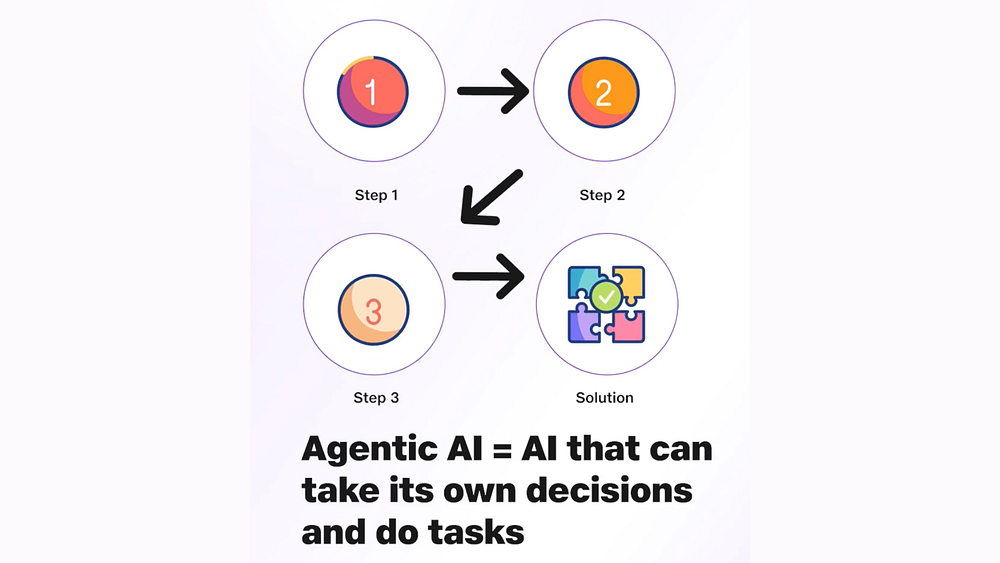
Instead of executing one isolated command, these systems:
- Understand objectives
- Break goals into smaller tasks
- Make decisions
- Use tools
- Learn from outcomes
- Adjust behavior over time
Think of the difference this way:
Traditional AI:
“Write a customer email.”
Agentic AI:
“Identify unhappy customers, draft personalized responses, send messages, monitor replies, and escalate unresolved issues.”
The second system behaves more like a digital worker.
That ability to act independently is what makes Agentic AI different.
Agentic AI Explained in Simple Terms
Imagine giving instructions to two people.
Person A
You say:
“Book my trip.”
They immediately ask:
- Where?
- What dates?
- Which hotel?
- What budget?
You guide every step.
Person B
You say:
“Plan a business trip to Delhi next week under ₹40,000.”
They:
- Research flights
- Compare hotels
- Build an itinerary
- Book options
- Send confirmation
Minimal supervision.
Agentic AI works more like Person B.
It receives goals, creates execution plans, and completes tasks.
How Agentic AI Works
Most Agentic AI systems combine several capabilities into one loop.
1. Goal Understanding
The AI receives an objective.
Example:
Increase newsletter subscriptions by 15%.
The system translates that objective into measurable actions.
2. Planning
The agent builds a sequence of steps.
Example plan:
- Analyze current conversion rates
- Generate new landing pages
- Run A/B tests
- Monitor results
- Optimize campaigns
3. Reasoning
The AI evaluates choices.
Questions it might ask:
- Which strategy has the highest probability?
- Is there enough data?
- Should I request more information?
4. Tool Usage
Agentic AI often connects to:
- Databases
- Search engines
- APIs
- CRM systems
- Analytics platforms
- Internal software
Tools extend capabilities beyond language generation.
5. Memory
Agents remember previous interactions.
Examples:
- User preferences
- Earlier decisions
- Historical outcomes
This creates continuity across tasks.
6. Action and Feedback
After execution:
- Results are measured
- Performance is evaluated
- Plans are adjusted
The loop repeats.
Core Components of an Agentic AI System
A typical architecture includes:
Input Layer
Receives goals and context.
↓
Planning Engine
Creates strategy.
↓
Reasoning Module
Makes decisions.
↓
Tool Layer
Executes external actions.
↓
Memory System
Stores relevant history.
↓
Evaluation Layer
Measures outcomes.
↓
Iteration Loop
This cycle allows Agentic AI to improve performance over time.
Agentic AI vs Traditional AI
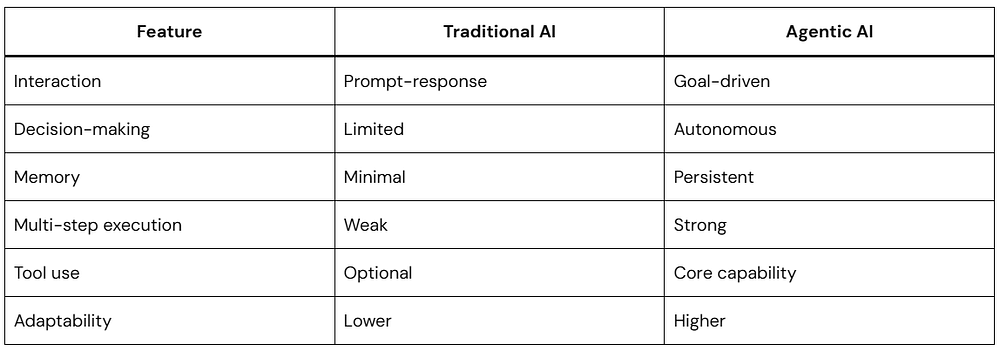
Traditional AI answers.
Agentic AI acts.
Types of Agentic AI Systems
1. Reactive Agents
Operate only on current inputs.
Example:
- Customer support bots
2. Goal-Based Agents
Select actions based on objectives.
Example:
- Scheduling assistants
3. Utility-Based Agents
Optimize outcomes using scoring systems.
Example:
- Recommendation engines
4. Learning Agents
Improve through experience.
Example:
- Autonomous operations platforms
Simple Agentic AI Example
The example below shows the core concept.
This is not a production agent. It demonstrates planning and action.
class SimpleAgent:

class SimpleAgent:

    def __init__(self):
        self.tasks = []

    def create_plan(self, goal):
        if "report" in goal.lower():
            self.tasks = [
                "collect_data",
                "analyze_data",
                "generate_report"
            ]

    def execute(self):
        for task in self.tasks:
            print(f"Running: {task}")

agent = SimpleAgent()

goal = "Create monthly sales report"

agent.create_plan(goal)
agent.execute()
Output
Running: collect_data<br>Running: analyze_data<br>Running: generate_reportcreate_plan()
Receives a goal and transforms it into executable steps.
This simulates planning.
execute()
Runs each task sequentially.
This simulates autonomous action.
Real Agentic AI systems expand this concept by adding:
- LLM reasoning
- API integrations
- retrieval systems
- memory
- monitoring
- error handling
Real-World Applications of Agentic AI
Customer Support
Agents can:
- Resolve tickets
- Search knowledge bases
- Escalate issues
- Follow up automatically
Software Development
AI agents can:
- Generate code
- Run tests
- Debug issues
- Deploy updates
Healthcare Administration
Agentic workflows can:
- Process records
- Schedule appointments
- Assist documentation
Human oversight remains essential.
Marketing Operations
Agentic AI can:
- Create campaigns
- Optimize content
- Analyze conversion data
- Recommend improvements
Financial Operations
Examples include:
- Fraud detection
- Portfolio monitoring
- Risk analysis
- Automated reporting
High-risk decisions still require governance.
Benefits of Agentic AI
Higher Productivity
Agents reduce repetitive work.
Faster Decision Cycles
Tasks that once took days may take minutes.
Better Scalability
Systems can manage thousands of workflows simultaneously.
Continuous Optimization
Agents improve processes through feedback loops.
Challenges and Limitations of Agentic AI
Agentic AI is powerful, but autonomy introduces complexity.
Reliability
Incorrect reasoning can produce poor outcomes.
Oversight Requirements
Human review remains critical.
Security Risks
Agents with broad permissions create operational risk.
Explainability
Understanding why decisions happen can be difficult.
Data Quality
Better inputs generally produce better outputs.
Best Practices for Building Agentic AI Systems
If you’re developing Agentic AI, start with these principles:
Define clear goals
Ambiguous objectives lead to inconsistent actions.
Limit permissions
Use least-privilege access.
Add human checkpoints
Especially for financial, legal, or healthcare use cases.
Measure outcomes
Track accuracy, latency, cost, and impact.
Build evaluation loops
Agents should continuously validate results.
The Future of Agentic AI
The next generation of software will likely move from:
Applications → Assistants → Autonomous Agents
Instead of opening ten tools to complete work, users may describe outcomes and let intelligent systems execute.
That does not mean humans disappear.
More likely, people shift from operators to supervisors.
The strongest implementations of Agentic AI combine:
- Human judgment
- AI execution
- Governance
- Continuous learning
Organizations that balance those pieces well will gain the most value.
Frequently Asked Questions
Is Agentic AI the same as generative AI?
No.
Generative AI creates content.
Agentic AI takes actions toward goals.
Many agentic systems use generative AI internally.
Does Agentic AI replace humans?
Not entirely.
Most successful implementations keep humans involved for approval, oversight, and exception handling.
Can Agentic AI learn on its own?
Some systems adapt using feedback and memory, but learning methods depend on architecture and governance controls.
Is Agentic AI safe?
It can be safe when designed with:
- monitoring
- permission controls
- audit logs
- human review
Conclusion
Agentic AI represents a major shift in how artificial intelligence operates.
Instead of waiting for commands, these systems can interpret goals, create plans, make decisions, and execute work.
That capability opens opportunities across business, development, operations, and customer experiences.
The key is not simply adding autonomy.
It is building autonomous systems that remain reliable, transparent, and aligned with human goals.
As the technology matures, understanding Agentic AI today will make it easier to navigate the future of intelligent systems.