

Generative AI has changed how we create digital content. From AI-generated art to synthetic voices, machines are now capable of producing content that looks surprisingly human. But when it comes to video generation, there’s one challenge that separates average AI videos from truly realistic ones: Temporal Coherence.
Without Temporal Coherence, AI-generated videos often appear unstable. Faces flicker. Objects change shape between frames. Lighting shifts unexpectedly. Movements feel unnatural.
With strong Temporal Coherence, videos become smooth, believable, and visually consistent.
In this guide, you’ll learn what Temporal Coherence means, why it matters in generative AI, how modern AI systems achieve it, and how developers implement it using machine learning models.
What Is Temporal Coherence?
Temporal Coherence refers to the consistency of visual elements across consecutive video frames.
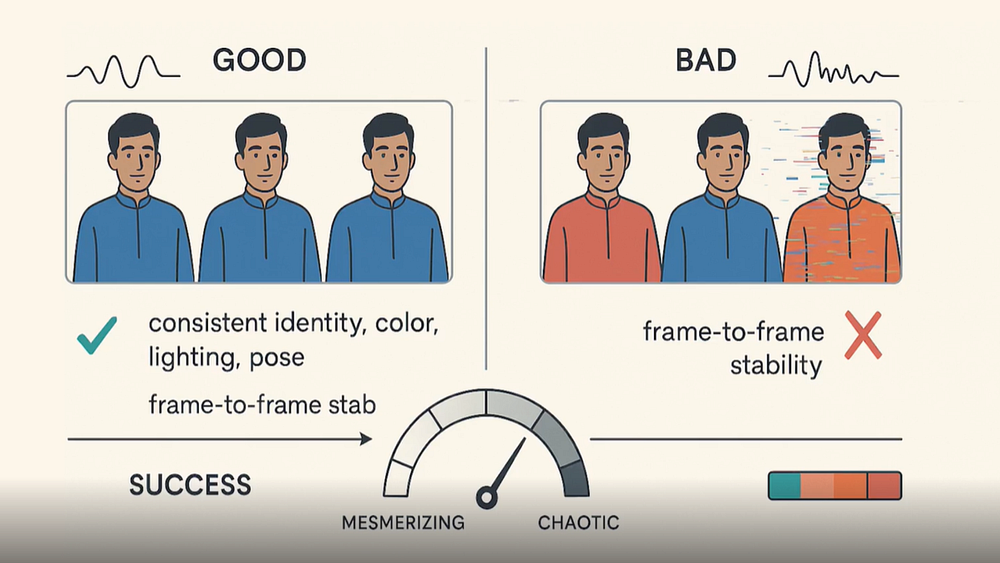
In simple words, it ensures that:
- Objects stay stable over time
- Colors remain consistent
- Lighting does not randomly change
- Characters maintain identity
- Motion appears natural and fluid
Imagine an AI-generated video of a person walking through a park.
If the person’s face changes slightly every frame, the video feels fake. If trees randomly appear and disappear, viewers immediately notice the inconsistency.
Temporal Coherence prevents these issues.
It helps AI maintain continuity from one frame to the next.
Why Temporal Coherence Matters in AI Video Generation
Humans are extremely sensitive to motion inconsistencies.
Even small visual changes between frames can make AI-generated videos feel uncanny or unrealistic.
That’s why Temporal Coherence is one of the most important concepts in:
- AI video generation
- Animation synthesis
- Deepfake technology
- Motion transfer
- AI filmmaking
- Virtual avatars
- Game rendering
- Video enhancement systems
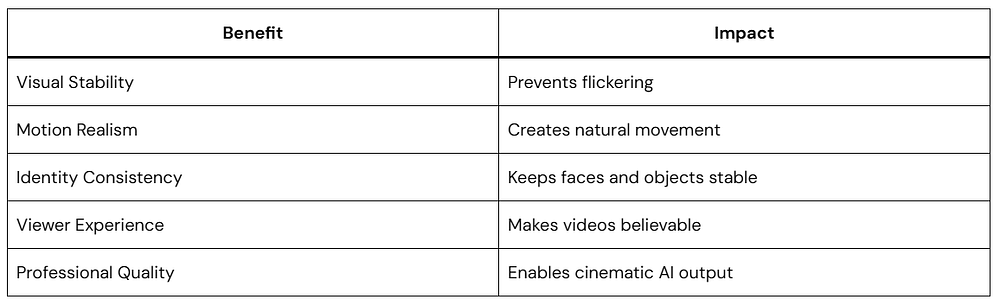
Strong Temporal Coherence improves:
Understanding the Problem: Frame-by-Frame Generation
Early AI image generators worked independently on each image.
That approach works fine for static pictures.
But video is different.
A video contains multiple frames played rapidly in sequence.
For example:
- 24 FPS = 24 frames per second
- 60 FPS = 60 frames per second
If an AI generates each frame separately without considering previous frames, inconsistencies appear.
The Core Problem With Video Generation
Common problems include:
Facial Flickering
A person’s eyes, hair, or skin tone changes slightly between frames.
Object Warping
Cars, buildings, or backgrounds distort unexpectedly.
Lighting Instability
Brightness changes randomly frame-to-frame.
Motion Jitter
Movement appears shaky or robotic.
These problems break realism immediately.
How Temporal Coherence Works in Generative AI
Modern AI systems use several advanced techniques to maintain Temporal Coherence.
Let’s explore the most important ones.
1. Optical Flow Tracking
Optical Flow estimates how pixels move between frames.
It helps AI understand motion patterns.
For example:
- A moving car shifts right
- A walking person changes position gradually
- Background objects move consistently
The AI tracks these movements to maintain continuity.
Why Optical Flow Matters
Without motion tracking:
- Objects jump randomly
With Optical Flow:
- Motion remains smooth and predictable
Optical Flow Example in Python
Here’s a simple OpenCV example that detects motion between frames.
import cv2
import numpy as np

# Open video
cap = cv2.VideoCapture("video.mp4")

# Read first frame
ret, frame1 = cap.read()
prev_gray = cv2.cvtColor(frame1, cv2.COLOR_BGR2GRAY)

while True:
    ret, frame2 = cap.read()

    if not ret:
        break

    gray = cv2.cvtColor(frame2, cv2.COLOR_BGR2GRAY)

    # Calculate optical flow
    flow = cv2.calcOpticalFlowFarneback(
        prev_gray,
        gray,
        None,
        0.5,
        3,
        15,
        3,
        5,
        1.2,
        0
    )

    # Visualize motion
    magnitude, angle = cv2.cartToPolar(flow[..., 0], flow[..., 1])

    print("Average Motion:", np.mean(magnitude))

    prev_gray = gray

cap.release()
This code calculates motion between consecutive video frames.
1. Read Video Frames
cap = cv2.VideoCapture("video.mp4")The video file is loaded.
2. Convert Frames to Grayscale
gray = cv2.cvtColor(frame2, cv2.COLOR_BGR2GRAY)Optical Flow works better on grayscale images.
3. Calculate Optical Flow
flow = cv2.calcOpticalFlowFarneback()This function estimates pixel movement between frames.
4. Measure Motion Strength
magnitude, angle = cv2.cartToPolar()The AI computes motion intensity and direction.
5. Maintain Temporal Coherence
The motion information helps AI models predict where objects should appear in the next frame.
That improves Temporal Coherence significantly.
2. Recurrent Neural Networks (RNNs)
Another method for Temporal Coherence uses memory-based neural networks.
RNNs remember previous frames while generating new ones.
This helps maintain consistency over time.
Why Memory Matters
If an AI remembers earlier frames:
- Faces stay consistent
- Clothing remains stable
- Backgrounds do not randomly change
Simple RNN Example
import torch
import torch.nn as nn

class VideoRNN(nn.Module):
    def __init__(self, input_size, hidden_size):
        super(VideoRNN, self).__init__()

        self.rnn = nn.RNN(input_size, hidden_size, batch_first=True)
        self.fc = nn.Linear(hidden_size, input_size)

    def forward(self, x):
        output, hidden = self.rnn(x)
        output = self.fc(output)
        return output

model = VideoRNN(128, 256)

sample_input = torch.randn(1, 10, 128)

output = model(sample_input)

print(output.shape)
This neural network processes sequences instead of single images.
RNN Layer
self.rnn = nn.RNN()The RNN remembers previous information across time steps.
Hidden State
The hidden state acts like memory.
It stores information from earlier frames.
Output Layer
self.fc = nn.Linear()The final layer predicts consistent future outputs.
How This Improves Temporal Coherence
Because the model remembers earlier frames, generated video becomes more stable and realistic.
3. Diffusion Models With Temporal Constraints
Modern AI video generators often use diffusion models.
These models generate videos gradually by removing noise step-by-step.
Popular systems include:
These systems add temporal constraints to keep frames consistent.
What Are Temporal Constraints?
Temporal constraints force generated frames to align with neighboring frames.
The AI checks:
- Motion continuity
- Object consistency
- Scene stability
- Camera movement
This dramatically improves Temporal Coherence.
4. Attention Mechanisms in Transformers
Transformer models changed modern AI.
They help AI focus on important parts of previous frames.
This improves:
- Object tracking
- Motion prediction
- Scene understanding
Transformers are widely used in advanced AI video systems today.
Frame Attention Example
import torch
import torch.nn as nn

attention = nn.MultiheadAttention(embed_dim=64, num_heads=8)

query = torch.rand(10, 1, 64)
key = torch.rand(10, 1, 64)
value = torch.rand(10, 1, 64)

output, weights = attention(query, key, value)

print(output.shape)
Attention helps the model decide:
“Which parts of previous frames are important for the next frame?”
This allows:
- Better motion consistency
- Stable object rendering
- Improved Temporal Coherence
Real-World Applications of Temporal Coherence
Temporal Coherence is essential in many industries.
AI Filmmaking
AI-generated movies need stable scenes and realistic motion.
Without Temporal Coherence, cinematic quality drops quickly.
Virtual Influencers and Avatars
AI avatars require consistent facial identity and expressions.
Temporal instability makes avatars look unnatural.
Video Upscaling
AI enhancement tools improve old videos frame-by-frame.
Temporal Coherence prevents flickering during enhancement.
Gaming and Real-Time Rendering
Modern games use AI rendering techniques to improve graphics performance while maintaining smooth motion.
Medical Imaging
AI-generated motion simulations in healthcare require stable temporal consistency for accurate analysis.
Challenges in Achieving Temporal Coherence
Even advanced AI systems still struggle with some issues.
Long Video Consistency
Maintaining coherence across long scenes remains difficult.
The longer the video:
- The harder continuity becomes
Complex Motion
Fast movement creates prediction challenges.
Examples:
- Explosions
- Crowd scenes
- Sports footage
Occlusion Problems
Objects disappearing behind others can confuse AI systems.
Computational Cost
Temporal Coherence requires massive GPU power and memory.
That’s one reason advanced AI video generation is expensive.
Future of Temporal Coherence in Generative AI
The future looks promising.
Researchers are improving:
- Long-term memory systems
- Motion-aware diffusion models
- Neural scene representations
- Real-time video generation
Soon, AI-generated videos may become nearly indistinguishable from real footage.
Best Practices for Developers
If you’re building AI video applications, these practices help improve Temporal Coherence.
Use Sequential Training Data
Train models on full video sequences instead of isolated frames.
Add Motion Loss Functions
Motion-aware loss functions improve stability.
Use Optical Flow Supervision
Motion tracking helps maintain frame consistency.
Combine CNNs With Transformers
Hybrid architectures often perform better for video generation tasks.
Apply Temporal Smoothing
Post-processing filters can reduce flickering.
Why Temporal Coherence Is the Foundation of Realistic AI Video
Temporal Coherence is not just a technical detail.
It’s the core reason modern AI videos feel smooth, believable, and cinematic.
Without it:
- Videos flicker
- Motion breaks
- Realism disappears
With strong Temporal Coherence:
- AI-generated characters stay consistent
- Motion feels natural
- Visual storytelling becomes immersive
As generative AI continues evolving, Temporal Coherence will remain one of the most critical technologies behind realistic video generation.
Frequently Asked Questions (FAQ)
What is Temporal Coherence in AI?
Temporal Coherence refers to maintaining visual consistency across video frames in AI-generated content.
Why is Temporal Coherence important?
It prevents flickering, instability, and unrealistic motion in generated videos.
Which AI models use Temporal Coherence?
Modern diffusion models, transformers, RNNs, and video generation systems use Temporal Coherence techniques.
Can AI generate fully realistic videos?
AI is improving rapidly, but maintaining perfect long-term Temporal Coherence is still challenging.
Conclusion
Generative AI is moving beyond static images into full cinematic video creation.
But realistic AI video depends heavily on one concept: Temporal Coherence.
Whether through optical flow, transformers, diffusion models, or memory networks, AI systems must understand how visuals evolve over time.
That’s what transforms disconnected frames into smooth, realistic experiences.
As research advances, Temporal Coherence will continue shaping the future of AI filmmaking, gaming, animation, and immersive digital media.