

Have you ever wondered what actually powers ChatGPT, Google Translate, or GitHub Copilot under the hood?
The answer is almost always the same: the Transformer architecture. It’s one of those rare inventions in computer science that didn’t just improve things a little — it completely rewrote the rules.
In this post, we’re going to break down the Transformer architecture from the ground up, without drowning you in intimidating math. Whether you’re a curious beginner or a developer looking to solidify your fundamentals, this guide is for you. Let’s dig in.
What Is the Transformer Architecture?
The Transformer architecture is a deep learning model design introduced in the landmark 2017 paper “Attention Is All You Need” by Vaswani et al. at Google. Before Transformers, most natural language processing (NLP) tasks relied on Recurrent Neural Networks (RNNs) and LSTMs (Long Short-Term Memory networks).
Those older models had a fundamental problem: they processed text word by word, in sequence. That means to understand the last word of a long sentence, the model had to “remember” everything that came before it — a bit like trying to recall the beginning of a movie after watching four hours of sequels.
The Transformer architecture threw that sequential approach out the window. Instead, it processes all words simultaneously and uses a clever mechanism called attention to understand relationships between words — no matter how far apart they are in a sentence.
That single change made everything faster, smarter, and more scalable.
Why Does Transformer Architecture Matter So Much?
Here’s a quick reality check: virtually every powerful AI language model you’ve heard of is built on the Transformer architecture.
- ChatGPT → GPT-4 (Transformer-based)
- Google Gemini → Transformer-based
- Meta LLaMA → Transformer-based
- BERT, T5, RoBERTa → All Transformer variants
- GitHub Copilot → Powered by Codex (Transformer-based)
This isn’t a coincidence. The Transformer architecture solved problems that had been bottlenecking AI research for years — scalability, long-range dependencies, and parallelism. That’s why it became the standard almost overnight.
The Big Picture: How a Transformer Works
Before we go deep, let’s look at the 30,000-foot view.
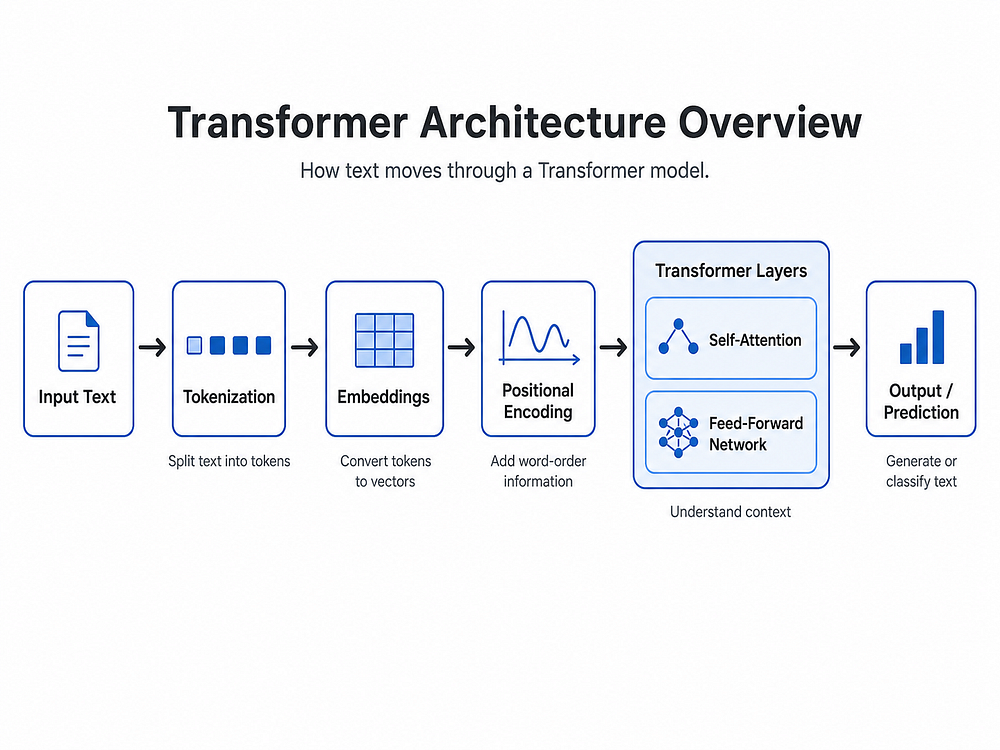
Imagine you’re asking an AI: “What is the capital of France?”
Here’s what happens inside a Transformer:
- Your text gets broken into tokens (small pieces of text)
- Each token is converted into a vector (a list of numbers) — this is called an embedding
- The model adds positional information so it knows word order
- A series of encoder and/or decoder layers process these vectors
- Inside each layer, an attention mechanism figures out which words relate to which
- The output is a prediction — in this case, “Paris”
Simple, right? Now let’s zoom into each piece.
Tokenization: Breaking Text Into Pieces
Before the Transformer architecture can do anything, your text needs to be converted into tokens.
Tokens aren’t always full words. They can be sub-words, characters, or punctuation marks, depending on the tokenizer. For example:
from transformers import GPT2Tokenizer

tokenizer = GPT2Tokenizer.from_pretrained("gpt2")
text = "Transformer architecture is amazing!"
tokens = tokenizer.encode(text)

print(tokens)
# Output: [8291, 16354, 10959, 318, 4998, 0]

decoded = tokenizer.decode(tokens)
print(decoded)
# Output: Transformer architecture is amazing!
Here,
- We load a pre-trained GPT-2 tokenizer
- We pass in a sentence and get back a list of integer IDs
- Each integer maps to a specific token in the model’s vocabulary
- The model never “reads” raw text — it only works with these numbers
This is the very first step in the Transformer pipeline. The richer and more consistent your tokenization, the better your model will perform.
Embeddings: Giving Numbers Meaning
Once we have token IDs, we convert them into embedding vectors — dense arrays of floating-point numbers that represent meaning.
Think of embeddings like coordinates on a map. Words with similar meanings cluster near each other in this high-dimensional space. “King” and “Queen” would be close together. “King” and “Broccoli” would be far apart.
import torch
import torch.nn as nn

vocab_size = 50000   # Number of unique tokens
embed_dim  = 512     # Size of each embedding vector

embedding_layer = nn.Embedding(vocab_size, embed_dim)

# Simulate a batch of 2 sentences, each with 10 tokens
token_ids = torch.randint(0, vocab_size, (2, 10))
embeddings = embedding_layer(token_ids)

print(embeddings.shape)
# Output: torch.Size([2, 10, 512])vocab_sizeis the total number of unique tokens the model knowsembed_dim = 512means each token becomes a 512-dimensional vector- The output shape
[2, 10, 512]means: 2 sentences × 10 tokens each × 512 numbers per token
These embeddings are learned during training — the model figures out the best numerical representation for each token by itself.
Positional Encoding: Telling the Model “Where” a Word Is
Here’s a subtle but critical issue: since the Transformer architecture processes all tokens at once (in parallel), it has no built-in sense of word order. “Dog bites man” and “Man bites dog” would look identical to it without some extra help.
That’s where positional encoding comes in. We add a special signal to each embedding that encodes its position in the sequence.
The original Transformer paper used sine and cosine functions for this:
import torch
import math

def positional_encoding(seq_len, embed_dim):
    pe = torch.zeros(seq_len, embed_dim)
    position = torch.arange(0, seq_len).unsqueeze(1).float()

    # Division term creates different frequencies for each dimension
    div_term = torch.exp(
        torch.arange(0, embed_dim, 2).float() *
        (-math.log(10000.0) / embed_dim)
    )

    # Even indices → sine, Odd indices → cosine
    pe[:, 0::2] = torch.sin(position * div_term)
    pe[:, 1::2] = torch.cos(position * div_term)

    return pe

pe = positional_encoding(seq_len=10, embed_dim=512)
print(pe.shape)
# Output: torch.Size([10, 512])
Why sine and cosine?
- They produce unique patterns for every position
- The model can generalize to sequences longer than what it saw during training
- Nearby positions have similar encodings, which helps the model understand proximity
You simply add this positional encoding to your embeddings before passing them into the Transformer layers. The model then bakes position awareness into everything it computes.
The Heart of It All: The Attention Mechanism
This is where the magic lives. The self-attention mechanism is the defining feature of the Transformer architecture — and the reason it leaves RNNs in the dust.
Self-attention lets every token in a sequence “look at” every other token and decide: “How relevant is that word to understanding me?”
For example, in the sentence:
“The bank by the river flooded after the rain.”
When the model processes the word “bank”, attention lets it look at “river” and “flooded” to understand that “bank” here means a riverbank — not a financial institution. That’s context-awareness in action.
Query, Key, and Value — The QKV Framework
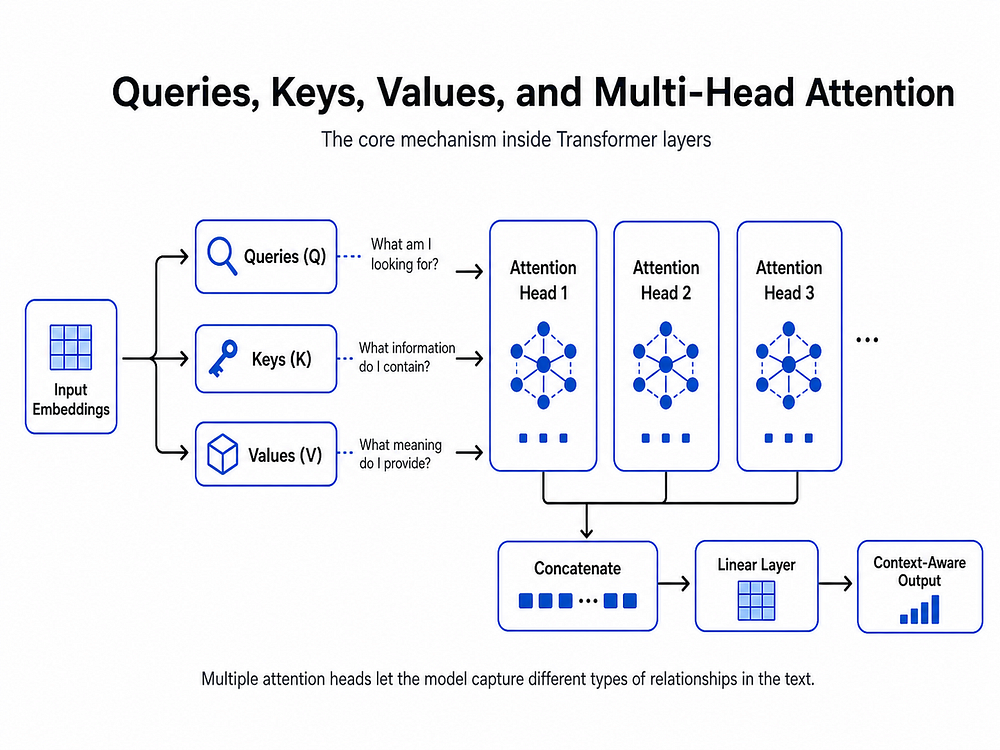
Attention is computed using three matrices: Query (Q), Key (K), and Value (V).
Here’s the intuition:
- Query: “What am I looking for?”
- Key: “What do I have to offer?”
- Value: “What information do I actually carry?”
import torch
import torch.nn.functional as F

def scaled_dot_product_attention(Q, K, V):
    """
    Q: Query matrix  → shape [batch, seq_len, d_k]
    K: Key matrix    → shape [batch, seq_len, d_k]
    V: Value matrix  → shape [batch, seq_len, d_v]
    """
    d_k = Q.size(-1)  # Dimension of the key vectors

    # Step 1: Compute raw attention scores (dot product of Q and K)
    scores = torch.matmul(Q, K.transpose(-2, -1))

    # Step 2: Scale to prevent huge values (which cause vanishing gradients)
    scores = scores / math.sqrt(d_k)

    # Step 3: Convert scores to probabilities with softmax
    attention_weights = F.softmax(scores, dim=-1)

    # Step 4: Multiply weights by values to get the output
    output = torch.matmul(attention_weights, V)

    return output, attention_weights

# Quick test
batch_size, seq_len, d_k = 2, 10, 64
Q = torch.rand(batch_size, seq_len, d_k)
K = torch.rand(batch_size, seq_len, d_k)
V = torch.rand(batch_size, seq_len, d_k)

output, weights = scaled_dot_product_attention(Q, K, V)

print(output.shape)    # torch.Size([2, 10, 64])
print(weights.shape)   # torch.Size([2, 10, 10])  ← attention map
This function implements scaled dot-product attention, a core idea behind Transformer models like GPT and BERT.
It works by comparing each query (Q) with all keys (K) using a dot product to measure similarity. These scores are then scaled (to keep values stable), passed through a softmax to turn them into probabilities, and used to weight the values (V).
The result is that each element in the sequence gathers relevant information from other elements, allowing the model to focus on what matters most.
The output of attention for each token is a weighted blend of all other tokens’ information, where the weights tell us how much to pay attention to each one.
Multi-Head Attention: Looking From Many Angles
One attention head is great, but different heads can learn to focus on different types of relationships simultaneously.
One head might focus on syntax. Another might focus on coreference (who “she” refers to). Another might track sentiment. This is Multi-Head Attention.
import torch.nn as nn
import math

class MultiHeadAttention(nn.Module):
    def __init__(self, embed_dim, num_heads):
        super().__init__()
        assert embed_dim % num_heads == 0, "embed_dim must be divisible by num_heads"

        self.num_heads = num_heads
        self.head_dim  = embed_dim // num_heads  # Each head gets a slice of the embedding
        self.embed_dim = embed_dim

        # Single projection matrices for all heads combined (efficient!)
        self.W_q = nn.Linear(embed_dim, embed_dim)
        self.W_k = nn.Linear(embed_dim, embed_dim)
        self.W_v = nn.Linear(embed_dim, embed_dim)
        self.W_o = nn.Linear(embed_dim, embed_dim)  # Final output projection

    def split_heads(self, x):
        """Reshape from [batch, seq, embed_dim] → [batch, heads, seq, head_dim]"""
        batch, seq, _ = x.size()
        x = x.view(batch, seq, self.num_heads, self.head_dim)
        return x.transpose(1, 2)

    def forward(self, x):
        # Project input to Q, K, V
        Q = self.split_heads(self.W_q(x))
        K = self.split_heads(self.W_k(x))
        V = self.split_heads(self.W_v(x))

        # Scaled dot-product attention for all heads at once
        d_k    = Q.size(-1)
        scores = torch.matmul(Q, K.transpose(-2, -1)) / math.sqrt(d_k)
        weights = torch.softmax(scores, dim=-1)
        attn_output = torch.matmul(weights, V)

        # Merge heads back: [batch, heads, seq, head_dim] → [batch, seq, embed_dim]
        batch, _, seq, _ = attn_output.size()
        attn_output = attn_output.transpose(1, 2).contiguous()
        attn_output = attn_output.view(batch, seq, self.embed_dim)

        # Final linear projection
        return self.W_o(attn_output)

# Test it
mha = MultiHeadAttention(embed_dim=512, num_heads=8)
x   = torch.rand(2, 10, 512)   # [batch=2, seq_len=10, embed_dim=512]
out = mha(x)
print(out.shape)
# Output: torch.Size([2, 10, 512])
This implements multi-head attention, an extension of scaled dot-product attention.
Instead of performing attention once, the input is projected into multiple smaller “heads,” each learning different relationships in the data. Attention is computed in parallel across these heads, and the results are then combined and projected back to the original dimension.
This allows the model to capture diverse patterns (e.g., syntax, context, long-range dependencies) more effectively than a single attention operation.
What to notice:
num_heads=8means we split the 512-dim embedding into 8 heads of 64 dims each- Each head runs attention independently on its own slice
- The results are concatenated and passed through a final linear layer
- The output shape is identical to the input — clean and composable
Feed-Forward Network: Processing Each Token Individually
After attention, each token’s representation passes through a small feed-forward network (FFN) — independently and identically for every position.
Think of this as a per-token “thinking step” where the model deepens its understanding after gathering context via attention.
class FeedForward(nn.Module):
    def __init__(self, embed_dim, ff_dim, dropout=0.1):
        super().__init__()
        self.net = nn.Sequential(
            nn.Linear(embed_dim, ff_dim),   # Expand: 512 → 2048
            nn.ReLU(),                       # Non-linearity
            nn.Dropout(dropout),             # Regularization
            nn.Linear(ff_dim, embed_dim),   # Contract: 2048 → 512
        )

    def forward(self, x):
        return self.net(x)

ffn = FeedForward(embed_dim=512, ff_dim=2048)
x   = torch.rand(2, 10, 512)
print(ffn(x).shape)
# Output: torch.Size([2, 10, 512])
The FFN expands the dimensionality (typically 4×), applies a non-linearity, then contracts back. This expansion gives the model extra “room to think” before compressing its insight back into the embedding.
Layer Normalization & Residual Connections
You’ve probably noticed that deep neural networks can be tricky to train — gradients explode or vanish, and small errors compound. The Transformer architecture tackles this with two simple but powerful tricks: residual connections and layer normalization.
class TransformerBlock(nn.Module):
    def __init__(self, embed_dim, num_heads, ff_dim, dropout=0.1):
        super().__init__()
        self.attention = MultiHeadAttention(embed_dim, num_heads)
        self.ffn       = FeedForward(embed_dim, ff_dim, dropout)
        self.norm1     = nn.LayerNorm(embed_dim)
        self.norm2     = nn.LayerNorm(embed_dim)
        self.dropout   = nn.Dropout(dropout)

    def forward(self, x):
        # Sub-layer 1: Multi-Head Attention + Residual + Norm
        attn_out = self.attention(x)
        x = self.norm1(x + self.dropout(attn_out))  # "Add & Norm"

        # Sub-layer 2: Feed-Forward + Residual + Norm
        ffn_out = self.ffn(x)
        x = self.norm2(x + self.dropout(ffn_out))   # "Add & Norm"

        return x

block = TransformerBlock(embed_dim=512, num_heads=8, ff_dim=2048)
x     = torch.rand(2, 10, 512)
out   = block(x)
print(out.shape)
# Output: torch.Size([2, 10, 512])
Why residual connections?
The x + sub_layer(x) pattern means the model adds the sub-layer’s output to its original input. If the sub-layer learns nothing useful, the input passes through unchanged — a built-in safety net that makes training much more stable.
Why layer normalization?
It normalizes the values inside each layer to have a mean of 0 and a standard deviation of 1. This keeps numbers in a healthy range throughout the network and speeds up training significantly.
Encoder vs. Decoder: Two Flavors of Transformer
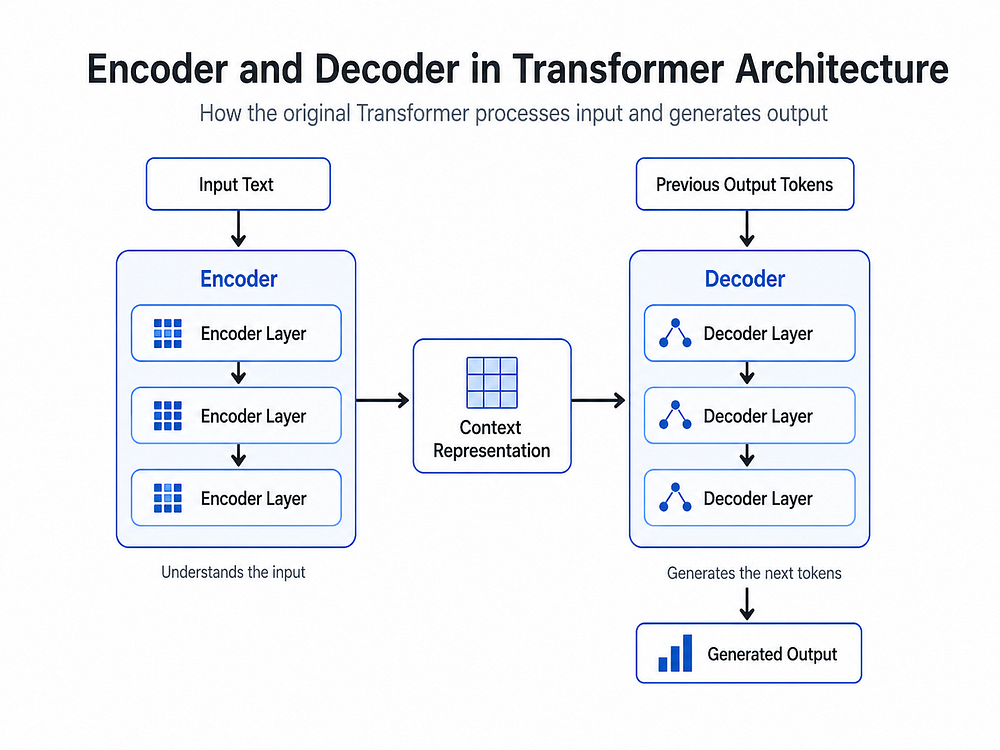
The original Transformer architecture had both an encoder and a decoder, each serving a distinct role.
The Encoder
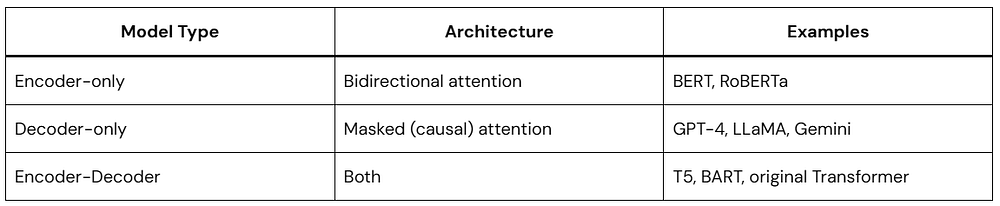
Reads the input and builds a rich contextual understanding of it. It uses bidirectional attention — every token can attend to every other token freely. Models like BERT are encoder-only.
Best for: Classification, named entity recognition, question answering (extractive)
The Decoder
Generates output one token at a time. It uses masked self-attention — when generating token #5, it can only look at tokens 1–4, not future ones. GPT models are decoder-only.
Best for: Text generation, autocomplete, creative writing, code generation
Encoder-Decoder (Seq2Seq)
Uses both halves together. The encoder processes the input; the decoder generates the output while attending to the encoder’s output. T5 and the original translation Transformers fall here.
Best for: Translation, summarization, question generation
Putting It All Together: A Minimal Transformer
Here’s a simplified but complete Transformer encoder that strings together everything we’ve covered:
class SimpleTransformerEncoder(nn.Module):
    def __init__(
        self,
        vocab_size,
        embed_dim,
        num_heads,
        ff_dim,
        num_layers,
        max_seq_len,
        dropout=0.1
    ):
        super().__init__()
        self.embedding         = nn.Embedding(vocab_size, embed_dim)
        self.positional_encode = nn.Embedding(max_seq_len, embed_dim)  # Learned positional encoding
        self.layers            = nn.ModuleList([
            TransformerBlock(embed_dim, num_heads, ff_dim, dropout)
            for _ in range(num_layers)
        ])
        self.norm    = nn.LayerNorm(embed_dim)
        self.dropout = nn.Dropout(dropout)

    def forward(self, token_ids):
        batch, seq_len = token_ids.shape

        # Create position indices [0, 1, 2, ..., seq_len-1]
        positions = torch.arange(seq_len, device=token_ids.device).unsqueeze(0)

        # Combine token embeddings + positional embeddings
        x = self.dropout(
            self.embedding(token_ids) + self.positional_encode(positions)
        )

        # Pass through each Transformer block
        for layer in self.layers:
            x = layer(x)

        return self.norm(x)  # Final normalization

# Build a small model
model = SimpleTransformerEncoder(
    vocab_size   = 10000,
    embed_dim    = 256,
    num_heads    = 8,
    ff_dim       = 1024,
    num_layers   = 4,
    max_seq_len  = 128
)

# Simulate a batch of token IDs
token_ids = torch.randint(0, 10000, (2, 20))  # Batch of 2, length 20
output    = model(token_ids)
print(output.shape)
# Output: torch.Size([2, 20, 256])

# Count parameters
total_params = sum(p.numel() for p in model.parameters())
print(f"Total parameters: {total_params:,}")
# Output: Total parameters: ~7,000,000
What you’re seeing:
vocab_size=10000→ 10,000 unique tokensembed_dim=256→ each token is a 256-dim vectornum_heads=8→ 8 parallel attention headsnum_layers=4→ 4 stacked Transformer blocks- The output is
[2, 20, 256]— contextual representations for every token
Stack more layers, add more heads, and use bigger embeddings — that’s essentially how you scale from this toy model to something like GPT-4.
Common Transformer Variants You Should Know
The Transformer architecture has spawned an entire family of specialized models.
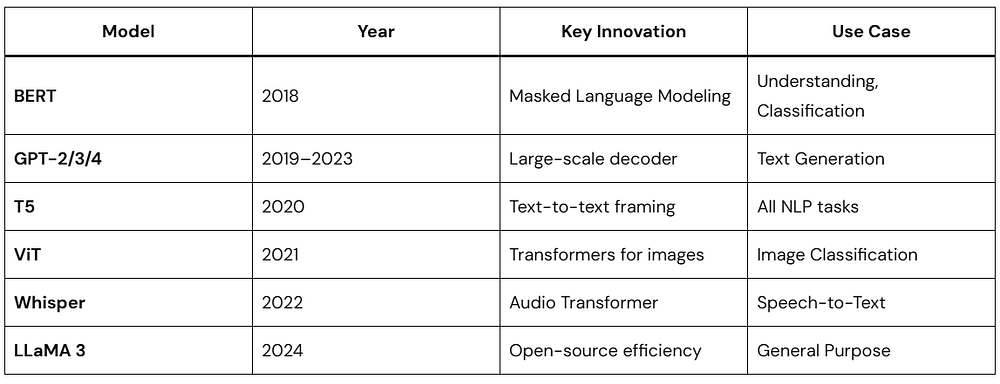
The core Transformer architecture is the same backbone in all of them — the differences are in training objectives, scale, and fine-tuning strategies.
Key Strengths of the Transformer Architecture
Let’s summarize why this architecture won:
Parallelism — Processes all tokens simultaneously, making it GPU-friendly and fast to train.
Long-range dependencies — Attention connects any two tokens regardless of distance, solving the “forgetting” problem of RNNs.
Scalability — Adding more layers, heads, and parameters consistently improves performance (the famous “scaling laws”).
Transfer learning — Pre-train once on massive data, fine-tune cheaply on specific tasks.
Versatility — The same architecture works for text, images, audio, code, protein sequences, and more.
Limitations Worth Knowing
No architecture is perfect. Here are the honest trade-offs:
Quadratic attention cost — Standard attention scales as O(n²) with sequence length. Long documents get expensive fast. (Solutions: Longformer, Flash Attention, sparse attention)
Data hungry — Transformers need massive datasets to shine. They don’t learn well from small data.
No inherent world model — They learn statistical patterns, not true reasoning or causality.
High compute cost — Training large Transformers requires significant hardware and energy.
Researchers are actively working on all of these. Flash Attention 2, Mixture of Experts (MoE), and State Space Models (like Mamba) are just a few of the innovations pushing past these limits.
Quick Recap: The Transformer Architecture at a Glance
Here’s everything we covered, condensed:
Raw Text
   ↓
Tokenization       → Convert text to integer token IDs
   ↓
Token Embeddings   → Map IDs to dense vectors
   ↓
Positional Encoding → Add position signals to preserve word order
   ↓
[Transformer Block] × N
  ├── Multi-Head Self-Attention  → Learn contextual relationships
  ├── Add & Norm (Residual)      → Stability + gradient flow
  ├── Feed-Forward Network       → Per-token processing
  └── Add & Norm (Residual)      → Stability + gradient flow
   ↓
Final Layer Norm
   ↓
Task-Specific Head  → Classification / Generation / etc.
   ↓
Output
Frequently Asked Questions
Q: Do I need to build a Transformer from scratch to use one?
No! Libraries like Hugging Face Transformers let you load and fine-tune pre-trained models in just a few lines of code. Building from scratch is purely for learning.
Q: What’s the difference between BERT and GPT?
BERT is encoder-only and reads the full sentence bidirectionally — great for understanding. GPT is decoder-only and generates text left-to-right — great for generation.
Q: How many parameters does a real LLM have?
GPT-2 has 1.5 billion. GPT-3 has 175 billion. LLaMA 3 comes in 8B, 70B, and 405B variants. Our example above had ~7 million — tiny by comparison.
Q: Is the Transformer architecture here to stay?
For the foreseeable future, yes. While alternatives like Mamba (State Space Models) show promise for certain tasks, Transformers remain the dominant architecture in production AI systems worldwide.
Conclusion
The Transformer architecture is arguably the most important breakthrough in AI of the past decade. It replaced slow, sequential models with a parallel, attention-driven design that scales beautifully — and it’s the foundation upon which the entire modern AI ecosystem is built.
If you’ve made it this far, you now understand:
- How tokenization and embeddings work
- Why positional encoding matters
- How self-attention (Q, K, V) computes context
- What multi-head attention adds
- How feed-forward layers and residuals stabilize training
- The difference between encoder-only, decoder-only, and seq2seq models
- How to build a minimal Transformer encoder in PyTorch
The best way to cement this knowledge? Clone a Hugging Face model, fine-tune it on a task you care about, and observe everything we discussed in action.
The Transformer changed everything. Now you know why.