Kotlin is a powerful programming language that fully supports Object-Oriented Programming (OOP). If you’re diving into Kotlin OOP Essentials, understanding classes, properties, and methods is crucial. This guide will break down these core concepts in a simple and engaging way, ensuring you master Kotlin’s OOP capabilities. Classes Classes serve as the fundamental building blocks in...
Generics are a powerful feature in Kotlin that allow us to write flexible and reusable code. However, one of the key aspects to understand when working with generics is Type Erasure. If you’ve ever tried to inspect a generic type at runtime and found unexpected behavior, you’ve likely encountered type erasure in Kotlin generics.
In this post, we’ll break down Type Erasure in Kotlin Generics, explain why it happens, and how to work around its limitations.
What is Type Erasure in Kotlin Generics?
Type erasure is a process where generic type information is removed (erased) at runtime. This happens because Kotlin, like Java, relies on the JVM, which does not retain generic type parameters during runtime. Instead, all generic types are replaced with their upper bound (often Any?) when the code is compiled.
This means that while we can specify a generic type at compile time, that type information is lost when the code is running. As a result, certain operations that rely on runtime type checking, such as type comparisons, become problematic.
Let’s first see a simple example to understand type erasure.
Kotlin
fun <T> printType(value: T) {println("Type: " + value!!::class.simpleName) //Expression in class literal has nullable type 'T'. so used '!!' to make the type non-nullable.}funmain() {printType(42) // Output: Type: IntprintType("Hello") // Output: Type: String}
Here, this will work well because value!!::class.simpleName gives us some runtime type information. But the problem arises when we try to inspect a collection of generics.
Consider the following code:
Kotlin
fun <T> isListOfStrings(list: List<T>): Boolean {return list is List<String>}funmain() {val strings = listOf("Kotlin", "Generics")println(isListOfStrings(strings))}
You might expect isListOfStrings(strings) to return true, but instead, it won’t compile (CE:Cannot check for instance of erased type ‘kotlin.collections.List<kotlin.String>) because Kotlin prevents direct generic type checks due to type erasure.
At runtime, List<String> and List<Int>both become justList<?>, meaning the type distinction is lost. This is what type erasure does—it removes specific type details.
Why Does Type Erasure Happen?
Kotlin runs on the Java Virtual Machine (JVM), which historically did not support reified generics. Java introduced generics in Java 5, but to maintain backward compatibility, the compiler removes type parameters at runtime. Kotlin inherits this behavior from Java.
For example, both List<String> and List<Int> compile down to just List in bytecode. This allows Java and Kotlin to remain compatible with older Java versions, but at the cost of losing runtime type safety.
How to Work Around Type Erasure
Even though type erasure limits what we can do at runtime, Kotlin provides workarounds to help mitigate these issues.
Use Reified Type Parameters with Inline Functions
One of Kotlin’s best solutions for type erasure is inline functions with reified type parameters. Normally, generic types are erased, but reified types retain their type information at runtime.
Since the function is inline, the compiler replaces it with actual type arguments during compilation, preserving type information.
Use Explicit Type Tokens
Another workaround is using explicit type tokens by passing a Class<T> reference:
Kotlin
fun <T> printType(type: Class<T>) {println("Type is: ${type.simpleName}")}funmain() {printType(String::class.java) // Output: Type is: String}
Conclusion
Understanding type erasure in Kotlin generics is essential when working with generics on the JVM. Due to type erasure, generic type information is removed at runtime, leading to certain limitations like the inability to check generic types, create instances, or overload functions based on generic parameters.
However, Kotlin provides solutions like reified type parameters, class references, and type tokens to mitigate these issues. By using these techniques, you can work around type erasure and write more effective, type-safe Kotlin code.
Exception handling is a crucial part of Java programming. It ensures that programs can gracefully handle unexpected situations without crashing. Java categorizes exceptions into checked and unchecked exceptions, but a lesser-known distinction exists within checked exceptions: fully and partially checked exceptions.
In this blog, we’ll explore how Java handles fully and partially checked exceptions, using clear explanations and examples to help you understand the topic deeply.
Understanding Checked Exceptions
Checked exceptions are exceptions that the compiler mandates you to handle explicitly. If your code calls a method that throws a checked exception, you must either handle it using a try-catch block or declare it using the throws keyword.
Here, FileNotFoundException is a checked exception. The compiler forces us to handle it because it is anticipated that a file may not always be available.
Fully Checked Exceptions in Java
A fully checked exception is an exception where all its subclasses are also checked exceptions. This means that whenever you work with this exception or any of its subclasses, the compiler enforces explicit handling.
Example of a Fully Checked Exception
IOException is a fully checked exception because all its subclasses, such as FileNotFoundException and EOFException, are also checked exceptions.
Here, the IOException must be handled explicitly, and its subclasses follow the same rule, making it a fully checked exception.
Partially Checked Exceptions in Java
A partially checked exception is an exception where some of its subclasses are checked exceptions, while others are unchecked exceptions.
The classic example of a partially checked exception is Exception. While many of its subclasses (like IOException and SQLException) are checked exceptions, others (like RuntimeException and its subclasses) are unchecked exceptions.
Here, Exception is a checked exception, but its subclass RuntimeException is unchecked, making Exception a partially checked exception.
How Java Handles Fully and Partially Checked Exceptions
Handling Fully Checked Exceptions
For fully checked exceptions, Java forces you to handle them at compile time. This ensures robust error handling but may sometimes lead to boilerplate code.
Handling Partially Checked Exceptions
With partially checked exceptions, the handling depends on which subclass you’re dealing with. If it’s a checked subclass (like IOException), you must handle it explicitly. However, if it’s an unchecked subclass (like NullPointerException), you don’t have to handle it, though it’s still advisable to do so where necessary.
Key Differences Between Fully and Partially Checked Exceptions
Exception Type
Fully Checked Exception
Partially Checked Exception
Definition
All subclasses are checked
Some subclasses are checked, some are unchecked
Example
IOException (all subclasses checked)
Throwable (Exception is checked, but Error is unchecked)
Compiler Handling
Must handle or declare all subclasses
Must handle only the checked subclasses
Some More Examples:
IOException: Fully checked exception.
RuntimeException: Unchecked exception.
InterruptedException: Fully checked exception.
Error: Unchecked exception.
Throwable: Partially checked exception.
ArithmeticException: Unchecked exception.
NullPointerException: Unchecked exception.
Exception: Partially checked exception.
FileNotFoundException: Fully checked exception.
Why Does Java Make This Distinction?
The main reason behind fully and partially checked exceptions is flexibility. Java enforces explicit handling for critical exceptions (e.g., file handling issues) while allowing unchecked exceptions (e.g., null pointer dereferences) to be handled at runtime without forcing developers to clutter code with try-catch blocks.
Conclusion
Understanding fully and partially checked exceptions in Java helps developers write better error-handling code. Fully checked exceptions require mandatory handling, ensuring code safety. Partially checked exceptions offer a balance between strict compilation checks and runtime flexibility. By mastering this distinction, you can write cleaner, more efficient Java programs while maintaining robust exception-handling practices.
By following Java’s structured approach to exception handling, you can build more reliable applications that gracefully recover from errors, leading to a better user experience and easier debugging.
Kotlin provides several function modifiers that improve code safety, performance, and flexibility. One such modifier is crossinline. If you’ve ever used inline functions in Kotlin, you might have come across crossinline but wondered why it’s needed. In this blog, we’ll break it down step by step, explaining why Kotlin has the crossinline modifier, when to use it, and how it works.
Before diving into crossinline, let’s first understand inline functions.
Understanding inline Functions in Kotlin
Kotlin allows functions to be marked as inline, meaning the compiler replaces function calls with the actual code at compile time. This helps reduce memory overhead caused by lambda expressions and improves performance.
Here, execute is an inline function, meaning the lambda function passed as block gets inlined at the call site, reducing the function call overhead.
Why Do We Need crossinline Modifier?
While inline functions provide performance benefits, they also introduce a limitation: they allow non-local returns from lambda expressions passed as parameters. This means a lambda can return from the calling function, which can sometimes be dangerous.
Kotlin
inlinefunperform(action: () -> Unit) {action()println("This will not execute if action() returns early")}funmain() {perform {println("Executing action")return// Non-local return, exits `main()` function }println("This will not print")}// OutputExecuting action
The return inside the lambda exits the main() function completely, skipping the rest of the code.
This Is Where crossinline Helps..!
If you don’t want the lambda to allow non-local returns, you use crossinline. This forces the lambda to behave like a regular function, preventing premature function exits.
How Does crossinline Modifier Work?
When a lambda parameter is marked with crossinline, it means that the lambda cannot use non-local returns but can still be inlined. This is particularly useful when passing the lambda to another function inside the inline function.
Kotlin
inlinefunperformSafely(crossinline action: () -> Unit) {println("Before action")// Lambda is stored in a Runnable object instead of being executed immediatelyval runnable = Runnable { action() } // Now the lambda is executed runnable.run()println("After action")}funmain() {performSafely {println("Executing action")// return // This will cause a compilation error }}// Output Before actionExecuting actionAfter action
Here, if we try to use return inside the lambda, Kotlin throws a compilation error because crossinline prevents non-local returns.
Without Runnable, the lambda (action) runs immediately inside performSafely.
But when we use Runnable, the lambda gets stored inside an object and runs later.
When We Should Use crossinline Modifier?
We should use crossinline in the following cases:
When passing a lambda to another function: If you store the lambda inside an object or pass it to another function, a non-local return might not make sense. crossinline prevents such issues.
When ensuring predictable execution: If you want the lambda to behave like a normal function (without returning early), crossinline ensures safe execution.
When working with multi-threading: If the lambda gets executed in another thread, a non-local return would cause unexpected behavior, making crossinline necessary.
Avoid using crossinline modifierif:
You need the flexibility of non-local returns.
The function is simple and doesn’t require lambda constraints.
The crossinline modifier in Kotlin serves a crucial role in ensuring safe execution of lambdas in inline functions. It prevents unexpected non-local returns, making code more predictable when working with higher-order functions.
Next time you’re writing an inline function and passing lambdas around, think about whether crossinline is needed to prevent unintended control flow issues.
Understanding the crossinline modifier helps you write more robust and predictable Kotlin code. Now that you know why Kotlin has crossinline, you can use it effectively in your projects..!
Type checking is a fundamental concept in programming, and Kotlin makes it simple with is and !is. These operators help you check whether an object is of a certain type and allow you to write safe and concise code. In this post, we’ll break down how type checks (is and !is) in Kotlin work, with clear examples to help you understand their use cases.
What Are Type Checks in Kotlin?
In Kotlin, every variable has a type. Sometimes, you need to confirm whether a variable belongs to a particular type before performing operations on it. The is operator checks if an object is of a specified type, while !is checks if it is not.
So, Kotlin provides two primary operators for type checking:
is – Checks if an object is of a particular type.
!is – Checks if an object is NOT of a particular type.
Let’s explore each of these in detail with examples.
How the is Operator Works
The is operator checks whether an object is of a specific type. If the object matches the type, it returns true; otherwise, it returns false.
Kotlin
funcheckType(value: Any) {if (valueis String) {println("It's a string with length: ${value.length}") } else {println("Not a string") }}funmain() {checkType("Hello, Kotlin!") // Output: It's a string with length: 14checkType(42) // Output: Not a string}
Here,
value is String checks if value is of type String.
If value is indeed a String, Kotlin automatically casts it within the if block.
This smart casting avoids explicit type conversion, making the code cleaner.
How the !is Operator Works
The !is operator is the opposite of is. It checks whether an object is not of a certain type.
Kotlin
funcheckNotType(value: Any) {if (value !is Int) {println("Not an Integer") } else {println("It's an Integer with value: $value") }}funmain() {checkNotType(100) // Output: It's an Integer with value: 100checkNotType("Kotlin") // Output: Not an Integer}
value !is Int returns true if value is not an Int.
If value is not an Int, it prints “Not an Integer”.
Otherwise, it prints the integer value.
Type Checking with when Expressions
Kotlin’s when expression works well with type checks (is and !is). This is especially useful for handling multiple types in a concise manner.
Kotlin
funidentifyType(value: Any) {when (value) {is String ->println("It's a string of length ${value.length}")is Int ->println("It's an integer: $value")is Double ->println("It's a double: $value")else->println("Unknown type") }}funmain() {identifyType("Hello") // Output: It's a string of length 5identifyType(10) // Output: It's an integer: 10identifyType(5.5) // Output: It's a double: 5.5identifyType(true) // Output: Unknown type}
when checks the type of value using is.
Depending on the type, it prints an appropriate message.
The else block ensures unhandled types don’t cause errors.
Smart Casting and Type Safety
One of Kotlin’s biggest advantages is smart casting, which reduces the need for explicit type casting.
Kotlin
funprintLength(obj: Any) {if (obj is String) {// Smart cast: No need to explicitly cast obj to Stringprintln("String length: ${obj.length}") }}funmain() {printLength("Kotlin") // Output: String length: 6}
Why is this useful?
No need for explicit casting (obj as String).
Improves readability and prevents unnecessary type conversion errors.
Common Mistakes and Best Practices
1. Forgetting the Smart Cast Scope
Kotlin
funinvalidCast(obj: Any) {if (obj is String) {// Smart cast works hereprintln(obj.length) }// println(obj.length) // Error: Smart cast is lost outside if block}
Solution: Store the casted value in a variable if needed outside the block.
is works with nullable types, but the variable remains nullable outside the if block.
Use the safe call operator (?.) to avoid NullPointerException.
3. Also, use when for Multiple Type Checks – This makes code cleaner and more readable.
Conclusion
Type checks (is and !is) in Kotlin are powerful tools for ensuring type safety and improving code clarity. The is operator checks if a variable belongs to a specific type, while !is ensures it doesn’t. These operators shine in if conditions, when expressions, and smart casting scenarios, making Kotlin a safer and more intuitive language.
Kotlin is a powerful and expressive language, but it introduces some challenges when dealing with mutable variables inside lambdas. If you’ve ever encountered issues while capturing mutable variables in Kotlin lambdas, you’re not alone. Many developers struggle with this concept, leading to unexpected behavior, performance concerns, and even compiler errors.
In this blog post, we’ll dive deep into capturing mutable variables in Kotlin lambdas, explore why developers often face difficulties, and discuss best practices to handle them effectively.
Before we dive into the struggles, let’s first understand what it means to capture a mutable variable in a lambda.
Understanding Capturing Mutable Variables in Kotlin Lambdas
A lambda expression in Kotlin can access and “capture” variables from its surrounding scope. This is a feature known as closures. However, how a variable is captured depends on whether it is mutable or immutable.
When a lambda function is defined inside another function, it can access variables declared in the outer function. If the lambda captures a mutable variable (a var), it essentially maintains a reference to that variable rather than making a copy of its value.
In this case, the lambda increment captures the mutable variable count, modifying it every time it is called.
Why Kotlin Developers Struggle with Capturing Mutable Variables
In above example, the lambda captures count, allowing it to be modified inside the lambda. But there’s a catch: Kotlin captures mutable variables by reference. This means any change inside the lambda affects the original variable.
This is where developers often struggle, especially when working with concurrency or multi-threading.
Concurrency Issues with Mutable Variables
When working in multi-threaded applications, capturing mutable variables in Kotlin lambdas can lead to unpredictable behavior due to race conditions.
Since sharedCount is modified by multiple threads, the final value is unpredictable. The correct way to handle this in Kotlin is by using Atomic variables:
Note: When you run both programs, you might think they give the same result. So, what’s the difference? The catch is that in the second case, the result is always consistent, no matter what. But in the first case, it’s unpredictable—even if it looks correct sometimes. Try stress testing it, and you’ll see the difference.
Detecting This Issue with a Stress Test
To reliably expose the race condition, increase the number of threads and iterations:
Kotlin
var sharedCount = 0funmain() {val workers = List(10000) {Thread {repeat(100) { sharedCount++ } } } workers.forEach { it.start() } workers.forEach { it.join() }println(sharedCount) // Unpredictable, usually much less than 1,000,000}
To really see the difference, try pushing the program harder — bump up the number of threads and iterations. Run the test, and you’ll notice the final count is all over the place, much lower than expected. That’s the unpredictability we’re talking about. Hope it’s clear now..!
Conclusion
Capturing mutable variables in Kotlin lambdas can be tricky due to variable scoping, reference capturing, and concurrency issues. By understanding these challenges and following best practices, you can write safer and more predictable Kotlin code.
If you’re struggling with such issues in your Kotlin projects, try applying the techniques discussed here.
Kotlin is known for its expressive and concise syntax, but one of the lesser-understood features is non-local returns in Kotlin lambda. This concept plays a crucial role in handling control flow inside lambda expressions. In this blog, we will explore what non-local returns are, how they work, and when to use them effectively.
What Are Non-Local Returns in Kotlin?
In Kotlin, functions use the return keyword to exit and pass back values. However, when using lambdas, returning from a lambda doesn’t always behave as expected.
A non-local return is when a return statement inside a lambda exits not just the lambda but also its enclosing function. This can be useful but also tricky to handle.
Kotlin
funfindEven(numbers: List<Int>) { numbers.forEach { number ->if (number % 2 == 0) {println("Even number found: $number")return// Non-local return } }println("This will not execute if an even number is found.")}funmain() {findEven(listOf(1, 3, 5, 4, 7, 9))}// Output Even number found: 4
Here, when number % 2 == 0 becomes true for 4, the return statement exits the findEven function entirely, skipping the last println() statement. This is what makes it a non-local return.
How Do Non-Local Returns Work?
Non-local returns work because Kotlin allows the return keyword inside a lambda to return from the nearest function that is marked as inline. The forEach function is inline, so the return statement jumps out of findEven() instead of just the lambda.
What if function is non-inline?
So in Kotlin, non-local returns (return from a lambda that exits the enclosing function) are allowed only inside inline functions. If a function is not marked as inline, attempting a non-local return will result in a compilation error.
Kotlin
funnonInlineFunction(action: () -> Unit) {action()}funmain() {nonInlineFunction {println("Before return")return// Compilation Error: 'return' is prohibited (or not allowed) here }}
This code fails because nonInlineFunction is not marked as inline. This happens because return inside a lambda tries to exit the main function, which is not allowed unless the function is inline.
So,
Non-local returns work only in inline functions.
If the function isn’t inline, the compiler throws an error.
To return only from the lambda (not the enclosing function), we use labeled returns (return@forEach).
Using Labeled Returns to Prevent Non-Local Returns
If we want to return only from the lambda and not from the enclosing function, we use a labeled return. Let’s modify the previous example (findEven):
Kotlin
funfindEvenCorrectly(numbers: List<Int>) { numbers.forEach { number ->if (number % 2 == 0) {println("Even number found: $number")return@forEach // Only exits this lambda, not findEvenCorrectly } }println("This will always execute.")}funmain() {findEvenCorrectly(listOf(1, 3, 5, 4, 7, 9))}// OUTPUTEven number found: 4This will always execute.
Here, return@forEach ensures that the return only exits the lambda without affecting findEvenCorrectly().
Why Use Non-Local Returns?
Non-local returns can be useful in early exits, especially in cases like:
Searching for an item: Exiting a function once a condition is met.
Validating data: Stopping execution once invalid data is detected.
Non-local returns in Kotlin lambda allow you to exit an enclosing function from within a lambda, but they work only with inline functions. They are useful in cases where early exits improve readability but should be used cautiously to avoid confusion.
Understanding this behavior helps you write more efficient and expressive Kotlin code. Try experimenting with inline and non-inline functions to see how Kotlin handles lambda returns in different scenarios..!
Kotlin lambdas are powerful, but they come with a constraint: they can only capture final (effectively immutable) variables from their enclosing scope. This can be a challenge when you need to modify a variable inside a lambda.
What Happens When Capturing Non-Final Variables in Kotlin Lambdas?
In Kotlin, when a lambda captures a non-final variable (i.e., a var variable), the variable is essentially wrapped in an internal object. This allows the lambda to modify the value of the variable even after it has been captured. This behavior is different from languages like Java, where lambda expressions can only capture final or effectively final variables.
Let’s look at a simple example where a lambda captures a non-final variable:
Kotlin
funouterFunction(): () ->Unit {var counter = 0return { println(counter++) }}// Place the following code inside main()val lambda = outerFunction()lambda() // prints "0"lambda() // prints "1"
Here,
outerFunction declares a variable counter initialized to 0.
It then returns a lambda that prints the current value of counter and increments it.
When we invoke lambda(), it prints the current value and increases it, demonstrating that counter retains its state across multiple lambda executions.
This behavior occurs because the variable counter is wrapped in an object that allows its modification even after being captured by the lambda.
You won’t believe this..! Wait a minute—just check the Java bytecode for outerFunction(), and you’ll see.
Java
@NotNullpublicstaticfinalFunction0outerFunction() {finalRef.IntRefcounter = new Ref.IntRef();counter.element = 0;// ...}
So, what is Ref.IntRef? Is it a mutable wrapper object?
Yes, Ref.IntRef is a mutable wrapper object used by the Kotlin compiler to allow lambdas to capture and modify integer values.
Actually, Ref.IntRef is an internal class in Kotlin’s standard library (kotlin.jvm.internal package). It is used when lambdas capture a mutable var of type Int because primitive types (int) cannot be directly captured by lambdas in Java due to Java’s pass-by-value nature.
This wrapper enables mutability, meaning that changes made inside the lambda affect the original variable.
Note- Kotlin provides similar wrappers for other primitive types also.
Now, What Happens When You Try to Modify a Captured Variable from Outside?
While lambdas can modify captured variables, you cannot modify those variables from outside the lambda. If you try to do so, the Kotlin compiler will raise an error.
The reason this code fails is that counter is wrapped inside an object, and the lambda is the only one with access to that object. Attempting to modify counter from outside the lambda results in a compilation error since counter is not a property of lambda itself.
Workaround (Recommended): Use an Explicitly Mutable Object
If you need to modify a captured variable externally, one approach is to use a mutable wrapper object. For example:
Kotlin
classCounter(varvalue: Int)funouterFunction(counter: Counter): () ->Unit {return { println(counter.value++) }}funmain() {val counter = Counter(0)val lambda = outerFunction(counter)lambda() // Prints "0"lambda() // Prints "1" counter.value = 10// Successfully modifies the counterprintln(counter.value) // Prints "10"}
Here,
Instead of a simple var counter, we use a Counter class to hold the value.
The lambda captures an instance of Counter, allowing external modification.
Now, counter.value can be updated externally without compiler errors.
Alternative (Just for Understanding): Using a Local Variable Inside the Lambda
Another approach is to declare a new local variable inside the lambda itself. However, note that this does not allow external modification of the original captured variable:
Capturing non-final variables in Kotlin lambdas provides flexibility, but it also requires an understanding of how Kotlin wraps these variables internally. While lambdas can modify captured variables, external modification is not allowed unless an explicit wrapper object is used. By following best practices, you can ensure safe and maintainable code when working with non-final variable captures in Kotlin.
By mastering these concepts, you’ll be better equipped to leverage Kotlin’s powerful functional programming features while writing efficient and robust code.
Kotlin provides a rich set of utilities for handling collections, making it easier to work with lists and arrays. However, many developers run into issues when trying to convert between different collection types, especially when moving from an immutable List to a MutableList or an Array. In this guide, we’ll cover all possible ways to perform these conversions efficiently and correctly.
Converting a List to a MutableList in Kotlin
By default, a List<T> in Kotlin is immutable, meaning you cannot modify its contents after initialization. If you attempt to change elements using indexing, you’ll encounter the following error:
Kotlin
No 'set'operator method providing array access
This happens because an immutable List does not have a set function. To modify a list, you must first convert it into a MutableList<T>. Let’s explore different ways to achieve this.
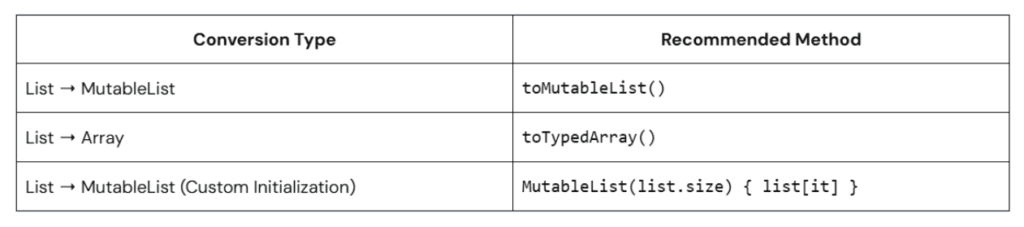
1. Using toMutableList() (Recommended)
This is the simplest and most idiomatic way to convert an immutable list into a mutable one:
Kotlin
val list = listOf(1, 2, 3) // Immutable listval mutableList = list.toMutableList() // Converts to MutableListmutableList[0] = 10// Works fineprintln(mutableList) // Output: [10, 2, 3]
Pros: Simple, clear, and concise.
Cons: Creates a new list instead of modifying the original one.
2. Using MutableList() Constructor
If you want to explicitly create a new MutableList, you can use:
Kotlin
val list = listOf("A", "B", "C")val mutableList = MutableList(list.size) { list[it] }mutableList[1] = "X"// Works fineprintln(mutableList) // Output: [A, X, C]
Pros: Useful when you need control over initialization.
Cons: Requires a manual copy of elements.
3. Using ArrayList() Constructor
Since ArrayList implements MutableList, you can convert a List to an ArrayList directly:
Kotlin
val list = listOf(4, 5, 6)val arrayList = ArrayList(list) // Converts to MutableListarrayList.add(7) // Works fineprintln(arrayList) // Output: [4, 5, 6, 7]
Pros: Works well with Java interoperability.
Cons: Less idiomatic in pure Kotlin.
4. Using toCollection()
This method allows you to add elements from an immutable list into a mutable collection:
Kotlin
val list = listOf(100, 200, 300)val mutableList = list.toCollection(ArrayList())mutableList.add(400) // Works fineprintln(mutableList) // Output: [100, 200, 300, 400]
Pros: Provides flexibility in choosing a mutable collection.
Cons: Slightly verbose.
Converting a List to an Array in Kotlin
While lists are more commonly used in Kotlin, there are cases where you need to convert a List<T> into an Array<T>, especially when interacting with Java APIs. Here are different ways to achieve this:
1. Using toTypedArray() (Recommended)
This method is the simplest way to convert a List<T> to an Array<T>:
Kotlin
val list = listOf(1, 2, 3)val array: Array<Int> = list.toTypedArray() // Converts List to Arrayprintln(array.joinToString()) // Output: 1, 2, 3
Pros: Works for all types and is easy to use.
Cons: Creates a new array instead of modifying an existing one.
2. Using Array(size) { list[it] } (Manual Copy)
If you need more control over initialization, you can create an array manually:
Kotlin
val list = listOf(10, 20, 30)val array = Array(list.size) { list[it] }println(array.joinToString()) // Output: 10, 20, 30
Pros: Provides explicit control over array creation.
Cons: Slightly verbose compared to toTypedArray().
Which Approach Should You Use?
Conclusion
Kotlin makes it easy to convert between lists and arrays with its powerful utility functions. While toMutableList() and toTypedArray() are the most recommended methods, other techniques can be useful depending on your specific use case. Understanding these conversions ensures smoother interoperability with Java and better flexibility when managing collections in Kotlin.
By following these best practices, you’ll write cleaner, and more efficient Kotlin code.
Kotlin provides powerful support for functional programming, and lambdas play a crucial role in making your code concise and expressive. However, when dealing with multiple lambda parameters, naming conflicts or ambiguity can arise. That’s where qualifying lambda parameters in Kotlin comes in.
In this blog, we’ll explore why qualifying lambda parameters is important, how to do it correctly, and practical examples to enhance your Kotlin skills.
Why Qualifying Lambda Parameters in Kotlin?
Lambda expressions in Kotlin often use implicit parameters such as it when there is only one argument. While this is convenient, it can sometimes lead to confusion, especially when working with nested lambdas or multiple parameters.
Here’s why qualifying lambda parameters in Kotlin is beneficial:
Improves Readability – Explicit names make it clear which variable is being referenced.
Avoids Ambiguities – When dealing with nested lambdas, qualifying parameters helps differentiate them.
Enhances Maintainability – Future changes to the code become easier when variables have meaningful names.
How to Qualify Lambda Parameters in Kotlin
Now that we understand the importance, let’s see different ways to qualify lambda parameters in Kotlin with practical examples.
Using Explicit Parameter Names
By default, Kotlin allows the use of it for single-parameter lambdas, but you can replace it with an explicit parameter name.
Kotlin
val numbers = listOf(1, 2, 3, 4, 5)numbers.forEach { number ->println("Number: $number")}
Here,
Instead of it, we explicitly define number to improve clarity.
When multiple people read the code, they can instantly understand what number represents.
Qualifying Parameters in Nested Lambdas
When working with nested lambdas, using it in both can create confusion. Explicit qualification resolves this issue.
Kotlin
val words = listOf("apple", "banana", "cherry")words.forEachIndexed { index, word ->println("Word #$index: $word")}
Instead of it, we explicitly declare index and word, making the lambda parameters clear.
Now let’s see a more complex example involving nested lambdas.
Kotlin
val people = listOf("Alice" to listOf("Reading", "Swimming"),"Bob" to listOf("Cycling", "Running"))people.forEach { (name, hobbies) -> hobbies.forEach { hobby ->println("$name likes $hobby") }}
Instead of using it twice, we qualify name and hobbies in the outer lambda.
Similarly, hobby is used in the inner lambda to prevent ambiguity.
Qualifying Lambda Parameters in Custom Higher-Order Functions
If you’re defining a higher-order function that takes a lambda as a parameter, you can specify the parameter names explicitly.
The operation lambda takes number: Int, making its purpose clear.
When calling operateOnNumbers, we use num instead of it to enhance clarity.
Using this to Qualify Parameters in Extension Functions
When working with extension functions inside lambdas, using this can help clarify scope.
Kotlin
classPerson(val name: String) {fungreet() {println("Hello, my name is $name") }}funPerson.introduce(action: Person.() -> Unit) {this.action()}val john = Person("John")john.introduce {greet()}
this.action() ensures that the lambda operates on the Person instance.
greet() is called within the scope of this, removing ambiguity.
Qualified Access
You can use a qualified name to access variables from an outer scope. For example, if you have a lambda inside a class method, you can access class-level properties using [email protected].
Kotlin
classExample {val property = "Hello from Example"funprintProperty() {val lambda = {println(this@Example.property) // Uses 'this@Example' to access class-level property }lambda() // Prints: Hello from Example }}funmain() {val example = Example() example.printProperty()}
Explanation:Inside a class method, you can access class-level properties using [email protected]. In this example, the lambda inside the printProperty method accesses the property of the Example class using this@Example, ensuring correct reference to the outer class.
Best Practices for Qualifying Lambda Parameters in Kotlin
To make your code clean and maintainable, follow these best practices:
Use explicit parameter names when dealing with multiple arguments.
Avoid relying too much on it, especially in nested lambdas.
Use meaningful names for lambda parameters instead of generic ones like x or y.
Leverage this in extension functions to clarify scope.
Ensure consistency across your codebase for better readability.
Qualifying lambda parameters in Kotlin is a simple yet powerful technique to improve code clarity and maintainability. By using explicit parameter names, handling nested lambdas carefully, and leveraging this where needed, you can write cleaner and more readable Kotlin code.
Next time you work with lambda functions, take a moment to qualify parameters appropriately—it’ll make a big difference in the long run!