

If you’ve been exploring cross-platform development with Kotlin, you’ve probably come across the debate: Kotlin Multiplatform vs Kotlin Native. At first glance, they can feel similar. Both let you use Kotlin beyond Android. Both promise code reuse. But they solve different problems.
In this guide, we’ll break down Kotlin Multiplatform & Kotlin Native to help you understand the real-world differences in 2026.
First, What Is Kotlin?
Kotlin is a modern programming language created by JetBrains. It’s concise, safe, and fully interoperable with Java.
fun greet(name: String): String {
    return "Hello, $name!"
}

fun main() {
    println(greet("amol"))
}
What’s happening here:
fundefines a functionname: Stringmeans the function expects a text input- The function returns a greeting string
- Kotlin automatically handles many things like null safety and type inference
Now let’s move into the real topic.
What Is Kotlin Native?
Kotlin Native is a technology that compiles Kotlin code directly into native machine code.
That means:
- No JVM (Java Virtual Machine)
- No Android runtime
- Runs directly on platforms like iOS, macOS, Linux, Windows
Simple Kotlin Native Example
import platform.Foundation.*

fun main() {
    println("Hello from Kotlin Native!")
}
This code can run as a standalone native binary.
Key Idea
Kotlin Native is about how your code runs.
It focuses on:
- Performance
- Native platform access
- Direct compilation
What Is Kotlin Multiplatform?
Kotlin Multiplatform (KMP) is a development approach.
It lets you:
- Share code across platforms (Android, iOS, Web, Backend)
- Keep platform-specific code where needed
Example Structure
shared/
├── commonMain/kotlin/     // Shared code
├── androidMain/kotlin/    // Android extras
└── iosMain/kotlin/ // iOS extras// Shared code
expect fun platformName(): String
fun greet(): String {
return "Hello from ${platformName()}"
}// Android implementation
actual fun platformName(): String = "Android"// iOS implementation
actual fun platformName(): String = "iOS"What’s happening here:
expectdeclares a function in shared codeactualprovides platform-specific implementations- You write logic once, customize where needed
Key Idea
Kotlin Multiplatform is about how you structure your codebase.
Kotlin Multiplatform vs Kotlin Native: Core Difference
Here’s the simplest way to understand it:
- Kotlin Native = a compiler/runtime technology
- Kotlin Multiplatform = a development framework/approach
They are not competitors. They work together.
How They Work Together
When comparing Kotlin Multiplatform vs Kotlin Native, it’s important to know this:
Kotlin Multiplatform uses Kotlin Native under the hood for iOS and other native targets.
So:
- You write shared code using Kotlin Multiplatform
- That shared code gets compiled using Kotlin Native (for iOS, etc.)
Real-World Example
Imagine you’re building a mobile app:
With Kotlin Multiplatform:
- Business logic (API calls, validation) is shared
- UI is written separately (SwiftUI for iOS, Jetpack Compose for Android)
With Kotlin Native:
- The shared code gets compiled into native iOS binaries
Key Differences Table
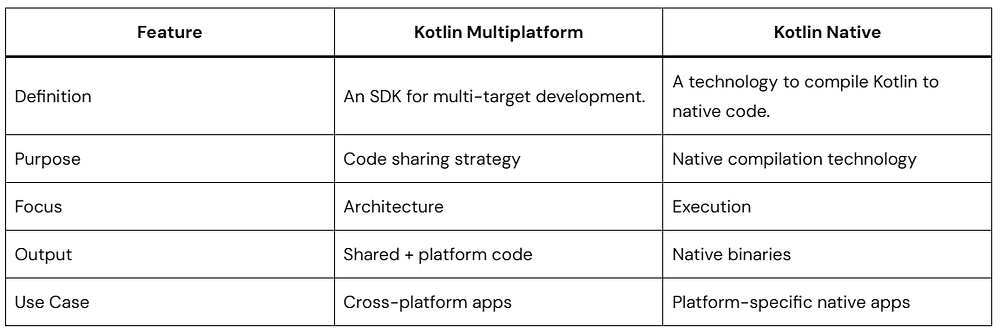
When Should You Use Kotlin Multiplatform?
Choose Kotlin Multiplatform if:
- You want to share business logic across platforms
- You’re building Android + iOS apps
- You want flexibility in UI development
- You care about reducing duplicate code
Example Use Cases:
- Fintech apps
- E-commerce apps
- APIs and SDKs
When Should You Use Kotlin Native?
Choose Kotlin Native if:
- You need a fully native application
You are building:
- CLI tools
- System-level software
- Performance-critical modules
- You don’t need cross-platform sharing
Performance: Kotlin Multiplatform vs Kotlin Native
This is a common question.
- Kotlin Native produces true native binaries, so performance is excellent
- Kotlin Multiplatform inherits that performance when targeting native platforms
However:
- KMP adds a layer of architecture complexity
- Native-only projects may be simpler for small apps
Developer Experience in 2026
Things have improved a lot.
Kotlin Multiplatform:
- Better tooling in Android Studio
- Improved iOS integration
- Faster builds
- More stable libraries
Kotlin Native:
- Improved memory management (no more freezing issues like early versions)
- Better debugging tools
Common Misconception
Many developers think:
“Kotlin Multiplatform & Kotlin Native is a choice between two competing tools.”
That’s not true.
You don’t choose one over the other…
You use them together..!
A Simple Mental Model
Think of it like this:
- Kotlin Multiplatform = the blueprint
- Kotlin Native = the engine that runs part of that blueprint
FAQ
Q: What is the difference between Kotlin Multiplatform and Kotlin Native?
Kotlin Multiplatform is a framework for sharing code across platforms, while Kotlin Native is a compiler that turns Kotlin code into native binaries. Kotlin Multiplatform often uses Kotlin Native for iOS and other native targets.
Q: Can Kotlin Multiplatform work without Kotlin Native?
Partially. It can target JVM and JS without Kotlin Native, but for iOS or native platforms, Kotlin Native is required.
Q: Which is better in 2026?
Neither is “better.” Kotlin Multiplatform is the higher-level solution, and Kotlin Native is part of how it works.
Conclusion
The debate around Kotlin Multiplatform vs Kotlin Native often comes from misunderstanding their roles.
If you remember just one thing, let it be this:
- Kotlin Multiplatform helps you share code
- Kotlin Native helps you run code natively
Together, they form a powerful toolkit for modern app development in 2026.